Crimson Publishers High Impact Journals

Showing posts with label journal of traditional and complementary medicine. Show all posts

Tuesday, May 3, 2022

Glucopuncture: Series of Regional Multiple Glucose 5% Injections_Crimson Publishers

Glucopuncture: Series of Regional Multiple Glucose 5% Injections by Jan Kersschot in Advances in Complementary & Alternative medicine_journal of traditional and complementary medicine


Definition

Glucopuncture is an injection-based therapy for the management of musculoskeletal conditions. It consists of multiple local injections with glucose or dextrose in low concentrations. These injections of G5W (Glucose 5% in Water) or D5W (Dextrose 5% in Water) seem to have a favorable effect on the repair mechanisms of damaged or inflamed tissues such as muscles, tendons, ligaments, cartilage, and peripheral nerves. The exact mechanism of action is not well understood and is likely multifactorial. Large randomized controlled trials are warranted to make specific recommendations regarding ideal protocols and indications. The introduction of a new term to describe these injections might give more exposure to its possible benefits among both patients and professional health care providers.

Keywords: Glucopuncture; Injection; Dextrose; Protocols; TRPV1 receptor; Scar tissue; Osteoarthritis; Glucose; Prolotherapy; Aerobic respiration; Cell metabolism; ATP-based theory; Primary sensory axons; Neurogenic inflammation; Chronic rotator

History

Glucose and dextrose injections have been used for decades in prolotherapy [1-26]. Prolotherapy - also known as proliferation therapy - is an injection technique which uses high concentrations of dextrose (more than 10% net concentration). Lidocaine is added to make the injections less painful. One of the aims of such hypertonic injections is to create an inflammatory reaction and / or stimulate formation of scar tissue in ligaments [27]. It is postulated that these dextrose injections stimulate tissue repair through growth factors and modulate pain modulation through agonism of TRPV1 receptor. As an increased matrix metalloproteinase (MMP) activity plays a major role in degradation of articular cartilage in patients with osteoarthritis, it is interesting to realize that glucose decreases IL-1β-induced MMP-1 expression in chondrocytes [28].

In prolotherapy, injections are given mainly into joint cavities, entheses, tendons and ligaments. It is suggested that prolotherapy can be as efficient as corticosteroid injections in the treatment of, for example, lateral epicondylosis [29,30], failed rotator cuff repair surgery [31] and chronic rotator cuff lesions [32]. It is also an interesting treatment modality in the treatment of osteoarthritis [33,34].

Over the last decade, low concentrations of dextrose 5% have become more popular [35-38]. These injections are administered into muscles, in the epidural liquid, near peripheral nerves [39], around tendons and in the skin. As the clinical effect is usually temporary, the sessions need to be repeated on a regular basis to achieve clinical effect. Although treatment protocols vary a lot, most physicians are using series of weekly injections of glucose 5% without adding local anesthetics in the treatment of osteoarthritis, carpal tunnel syndrome, back pain, sports injuries, whiplash, failed back surgery syndrome, regional pain syndrome and neuropathic pain.

The ATP Hypothesis

Glucose is a monosaccharide which functions as a precursor for many carbohydrates found in organisms. It is considered as the prime energy source for cellular health. One glucose molecule result in 38 ATP molecules during the aerobic respiration. The conversion of ATP into ADP releases 30.6kJ/mol energy to the cells. In other words, glucose can be considered as a provider of energy to the cell metabolism.

When tissues are damaged because of trauma, overuse or other causes, the cells need to regenerate as quickly as possible. This tissue regeneration requires an additional amount of energy. When energy supply is limited, complete recovery of the tissue may be slow or even impossible, leading to poor tissue healing. It is postulated that injecting glucose in the extracellular space of the damaged tissue may enhance ATP supply to the cells and as a result support and speed up local recovery. However, there is no strong evidence for this hypothesis so far. Only one study seems to support (partially) this ATP-based theory. In this recent study the authors have illustrated that injecting ATP in the spinal cord stimulates regeneration of primary sensory axons [40].

In the last decade, more findings about injections of low concentrations of glucose have been published. A prospective, randomized, double-blind, controlled trial illustrated a six-month efficacy of perineural dextrose for carpal tunnel syndrome [41]. Dextrose 5% injections also seem to be beneficial for patients with chronic low back pain (failed back surgery syndrome) [42]. Epidural injection of 5% dextrose is reported to reduce pain temporary, but a waning pain control at 2 weeks suggests the need to assess the effect of serial dextrose epidural injections [43]. Caudal epidural injection of 10mL of D5W (without anesthetic) every 2 weeks for 4 treatments and then as needed for 1 year resulted in a consistent pattern of post injection analgesia [44]. This suggests a potential sensorineural effect of serial dextrose injections on neurogenic pain, probably by targeting the peptidergic nociceptors. One proposed mechanism of action suggests that dextrose binds to presynaptic calcium channels and inhibits the release of substance P and CGRP, thereby decreasing neurogenic inflammation [37].

These observations generate the idea that glucose 5% injections (without anesthetic) might be an inexpensive and safe option in the treatment of sports injuries, carpal tunnel syndrome, musculoskeletal pain, whiplash, regional pain syndrome and osteoarthritis. In contrast to cortisone, longer series of such injections every week or every two weeks have little or no side effects. The downside of Glucopuncture is that more sessions are needed to attain symptom resolution when compared to cortisone injections or to PRP injections [45,46], although one study showed that intraarticular glucose injections in the sacroiliac joint produced longer lasting effects than those of steroid injections [47]. In other words, steroid injections provide probably better results on the short run while glucose injections may be superior when it comes to long term results.

Clinical Application of Glucopuncture

Glucose in a five percent water solution (G5W) is a sterile liquid which can be injected without adding a local anesthetic. Adverse reactions are not well documented but appear to be extremely rare (e.g., itching, allergic dermatitis). Temporary injection site tenderness and bruising are the most frequently reported side effects. Injections are given intracutaneously, subcutaneously, in joints and into muscles. Glucose 5% can also be injected around tendons, ligaments, and peripheral nerves. Usually multiple injections (5 to 10 injections) are given in the zone of tissue repair or in the pain zone (the zone which the patient points out as the painful area). Needles frequently used are 30G (1/2”), 27G (3/4” or 1 1/2”) and 23G (3”). The total volume injected varies from 5 to 15ml in each treatment zone. In acute cases, injections are given once or twice a week, and one to five sessions might be necessary. In chronic cases, five to ten sessions (first once a week and then every two weeks) might be needed to attain tissue repair and / or lasting pain relief.

When glucose (or dextrose) is injected in normal healthy tissue, the influence on cell metabolism is minimal. But it is hypothesized that when glucose is injected in tissues which lack energy supply, the added extracellular glucose may lead to more ATP production in the cell and thus support the natural repair processes in those damaged cells. When injected into a muscle tear, the muscle fibers seem to heal quicker and better [48]. As a result, it seems an interesting option to use injections of G5W in trigger points for the treatment of myofascial pain. Glucose injections are also applied in peripheral nerves. Especially chronic inflamed nerves seem to react well to Glucopuncture. Even the peripheral nerve endings in the skin and under the skin recover quicker from neural inflammation when injected with glucose 5%. More clinical research might illustrate the hypothesis that chronic regional pain syndrome [49] might be treated successfully and safely with subcutaneous (SC) or intracutaneous (IC) glucose injections.

Conclusion

Glucopuncture is a new term to describe regional multiple injections with glucose 5%. It is hypothesized that a series of sessions of multiple injections of glucose 5% supports the repair of damaged tissue such as muscles, tendons, ligaments, cartilage, and peripheral nerves. This injection technique can be applied as a single or as an adjuvant modality in the treatment of sports injuries, posttraumatic pain, osteoarthritis, neuropathic pain, and myofascial pain. More clinical and fundamental research in this area is necessary to verify the mechanism of action, safety, and long-term results of this technique.

References

  1. Reeves KD, Sit RW, Rabago DP (2016) Dextrose prolotherapy: a narrative review of basic science, clinical research, and best treatment recommendations. Phys Med Rehabil Clin N Am 27(4): 783-823.
  2. Distel LM, Best TM (2011) Prolotherapy: a clinical review of its role in treating chronic musculoskeletal pain. PM R 3(6 Suppl 1): S78-81.
  3. Ganji R (2018) Dextrose prolotherapy for improvement of rotator cuff lesions: ready for clinical use? Hong Kong Med J 24(4): 429-430.
  4. Hauser RA, Lackner JB, Steilen MD, Harris DK (2016) A systematic review of dextrose prolotherapy for chronic musculoskeletal pain. Clin Med Insights Arthritis Musculoskelet Disord 9: 139-159.
  5. Topol GA, Podesta LA, Reeves KD, Marcia MG, Lanny LJ, et al. (2016) Chondrogenic effect of intra-articular hypertonic dextrose (prolotherapy) in severe knee osteoarthritis. PM R 8(11): 1072-1082.
  6. Rabago D, Kijowski R, Woods M, Patterson JJ, Mundt M, et al. (2013) Association between disease-specific quality of life and magnetic resonance imaging outcomes in a clinical trial of prolotherapy for knee osteoarthritis. Arch Phys Med Rehabil 94(11): 2075-2082.
  7. Rabago D, Nourani B (2017) Prolotherapy for osteoarthritis and tendinopathy: a descriptive review. Curr Rheumatol Rep 19(6): 34.
  8. Rabago D, Kansariwala I, Marshall D, Nourani B, Stiffler JM, et al. (2019) Dextrose prolotherapy for symptomatic knee osteoarthritis: feasibility, acceptability, and patient-oriented outcomes in a pilot-level quality improvement project. J Altern Complement Med 25(4): 406-412.
  9. Kim BK, Shin JY, Seo KM (2001) The effect of prolotherapy for the chronic pain of musculoskeletal system. The Journal of the Korean Academy of Rehabilitation Medicine 25: 128-133.
  10. Kim MY, Na YM, Moon JH (1997) Comparison on treatment effects of dextrose water, saline, and lidocaine, and saline for trigger point injections. J Korean Acad Rehabil Med 21: 967-973.
  11. Chou Y, Chiou HJ, Wang HK, Lai YC (2020) Ultrasound-guided dextrose injection treatment for chronic myofascial pain syndrome: a retrospective case series. J Chin Med Assoc 83(9): 876-879.
  12. Lin CL, Huang CC, Huang SW (2019) Effects of hypertonic dextrose injection in chronic supraspinatus tendinopathy of the shoulder: a randomized placebo-controlled trial. Eur J Phys Rehabil Med 55(4): 480-487.
  13. Lee DH, Kwack KS, Rah UW, Yoon SH (2015) Prolotherapy for refractory rotator cuff disease: retrospective case-control study of 1-year follow-up. Arch Phys Med Rehabil 96(11): 2027-2032.
  14. Louw WF, Reeves KD, Lam SKH, Cheng AL, Rabago D (2019) Treatment of temporomandibular dysfunction with hypertonic dextrose injection (prolotherapy): a randomized controlled trial with long-term partial crossover. Mayo Clin Proc 94(5): 820-832.
  15. Arias VPI, Tovilla ZCA, Legorreta RBG, Wajid BF, Dory MR, et al. (2019) Prolotherapy for knee osteoarthritis using hypertonic dextrose vs other interventional treatments: systematic review of clinical trials. Adv Rheumatol 59(1): 39.
  16. Catapano M, Zhang K, Mittal N, Sangha H, Onishi K, et al. (2020) Effectiveness of dextrose prolotherapy for rotator cuff tendinopathy: a systematic review. PM R 12(3): 288-300.
  17. Hsieh PC, Chiou HJ, Wang HK, Lai YC, Lin YH (2019) Ultrasound-guided prolotherapy for acromial enthesopathy and acromioclavicular joint arthropathy: a single-arm prospective study. J Ultrasound Med 38(3): 605-612.
  18. Bayat M, Raeissadat SA, Mortazavian BM, Rahimi DS (2019) Is dextrose prolotherapy superior to corticosteroid injection in patients with chronic lateral epicondylitis? a randomized clinical trial. Orthop Res Rev 11: 167-175.
  19. Bertrand H, Reeves KD, Bennett CJ, Bicknell S, Cheng AL (2016) Dextrose prolotherapy versus control injections in painful rotator cuff tendinopathy. Arch Phys Med Rehabil 97(1):17-25.
  20. Hooper RA, Ding M (2004) Retrospective case series on patients with chronic spinal pain treated with dextrose prolotherapy. J Altern Complement Med 10(4): 670-674.
  21. Fullerton BD (2018) Prolotherapy for the thoracolumbar myofascial system. Phys Med Rehabil Clin N Am 29(1): 125-138.
  22. Ongley MJ, Inklebarger J (2020) The diagnosis and management of upper gluteal pain. Journal of Prolotherapy 12: e1009-e1014.
  23. Sit RW, Chung VCh, Reeves KD, David R, Keith KC et al. (2017) Hypertonic dextrose injections (prolotherapy) in the treatment of symptomatic knee osteoarthritis: A systematic review and meta-analysis. Sci Rep 6: 25247.
  24. Nagori SA, Jose A, Gopalakrishnan V, Roy ID, Chattopadhyay PK, et al. (2018) The efficacy of dextrose prolotherapy over placebo for temporomandibular joint hypermobility: A systematic review and meta-analysis. J Oral Rehabil 45(12): 998-1006.
  25. Rhatomy S, Evlin M, Rizki R (2020) Dextrose prolotherapy for muscle, tendon and ligament injury or pathology: a systematic review. Annual Research & Review in Biology 2020: 43-62.
  26. Ozkan O, Torgutalp SS, Karacoban L, Donmez G, Korkusuz F (2020) Do pain and function improve after dextrose prolotherapy or autologous platelet-rich plasma injection in longstanding groin pain? Monten J Sports Sci Med 9(2): 5-12.
  27. Hackett GS, Hemwall GA, Montgomery GA (1993) Ligament and tendon relaxation treated by prolotherapy. Oak Park, USA
  28. Wu TJ, Lin CY, Tsai CH, Huang YL, Tang CH (2018) Glucose suppresses il-1β-induced mmp-1 expression through the fak, mek, erk, and ap-1 signaling pathways. Environ Toxicol 33(10):1061-1068.
  29. Carayannopoulos A, Borg SJ, Sokolof J, Meleger A, Rosenberg D (2011) Prolotherapy versus corticosteroid injections for the treatment of lateral epicondylosis: a randomized controlled trial. PM R 3(8): 706-715.
  30. Yelland M, Rabago D, Ryan M, Shu KN, Dinusha V, et al. (2019) Prolotherapy injections and physiotherapy used singly and in combination for lateral epicondylalgia: a single-blinded randomized clinical trial. BMC Musculoskelet Disord 20(1): 509.
  31. Akpancar S, Örsçelik A, Seven MM, Koca K (2019) The effectiveness of prolotherapy on failed rotator cuff repair surgery. Turk J Phys Med Rehabil 65(4): 394-401.
  32. Seven MM, Ersen O, Akpancar S, Ozkan H, Turkkan S, et al. (2017) Effectiveness of prolotherapy in the treatment of chronic rotator cuff lesions. Orthop Traumatol Surg Res 103(3): 427-433.
  33. Works, Cynthia MD; Miller, Jesse DO (2020) Is prolotherapy effective in reducing pain and improving function in patients with knee OA? Evidence-Based Practice: 23(3): 19-20.
  34. Gül D, Orsçelik A, Akpancar S (2020) Treatment of osteoarthritis secondary to developmental dysplasia of the hip with prolotherapy injection versus a supervised progressive exercise control. Med Sci Monit 26: e919166.
  35. Köroğlu Ö, Orscelik A, Karasimav Ö, Demir Y, Solmaz İ (2019) Is 5% dextrose prolotherapy effective for radicular low back pain? Gulhane Medical Journal 61(3): 123-127.
  36. Lyftogt J (2007) Subcutaneous prolotherapy for achilles tendinopathy: the best solution? Australasian Musculoskeletal Medicine p. 107-109.
  37. Weglein AD (2001) Neural prolotherapy. Journal of Prolotherapy 3(2): 639-643.
  38. Paprottka KJ, Lehner A, Fendler WP, Harun I, Axel R, et al. (2016) Reduced periprocedural analgesia after replacement of water for injection with glucose 5% solution as the infusion medium for 90y-resin microspheres. J Nucl Med 57(11): 1679-1684.
  39. Chen SR, Shen YP, Ho TY, Chen LC, Wu YT (2018) Ultrasound-guided perineural injection with dextrose for treatment of radial nerve palsy: A case report. Medicine (Baltimore) 97(23): e10978.
  40. Wu D, Lee S, Luo J, Xia H, Gushchina S, et al. (2018) Intraneural injection of atp stimulates regeneration of primary sensory axons in the spinal cord. J Neurosci 38(6): 1351-1365.
  41. Wu YT, Ho TY, Chou YC, Ming JK, Tsung YL, et al. (2017) Six-month efficacy of perineural dextrose for carpal tunnel syndrome: a prospective, randomized, double-blind, controlled trial. Mayo Clin Proc 92(8): 1179-1189.
  42. Solmaz İ, Akpancar S, Örsçelik A, Yener KÖ, Gül D (2019) Dextrose 5% injections for failed back surgery syndrome: a consecutive case series. Eur Spine J 28(7): 1610-1617.
  43. Maniquis SL, Dean RK, Jeffrey RH, Lyftogt J, Cassie GC, et al. (2016) Short term analgesic effects of 5% dextrose epidural injections for chronic low back pain: a randomized controlled trial. Anesth Pain Med 7(1): e42550.
  44. Maniquis SL, Reeves KD, Rosen HJ, John L, Cassie GC, et al. (2018) Analgesic effect and potential cumulative benefit from caudal epidural d5w in consecutive participants with chronic low-back and buttock/leg pain. J Altern Complement Med 24(12): 1189-1196.
  45. Wu YT, Ke MJ, Ho TY, Li TY, Shen YP, et al. (2018) Randomized double-blinded clinical trial of 5% dextrose versus triamcinolone injection for carpal tunnel syndrome patients. Ann Neurol 84(4): 601-610.
  46. Shen YP, Li TY, Chou YC, Tsung YH, Ming JK, et al. (2019) Comparison of perineural platelet-rich plasma and dextrose injections for moderate carpal tunnel syndrome: A prospective randomized, single-blind, head-to-head comparative trial. J Tissue Eng Regen Med 13(11): 2009-2017.
  47. Kim WM, Lee HG, Jeong CW, Kim CM, Yoon MH (2010) A randomized controlled trial of intra-articular prolotherapy versus steroid injection for sacroiliac joint pain. J Altern Complement Med (12): 1285-1290.
  48. Tsai SW, Hsu YJ, Lee MC, Huang HE, Huang CC, et al. (2018) Effects of dextrose prolotherapy on contusion-induced muscle injuries in mice. Int J Med Sci 15(11): 1251-1259.
  49. Thor JA, Mohamed HNH, Halil H, Suhaimi A (2017) Perineural injection therapy in the management of complex regional pain syndrome: a sweet solution to pain. Pain Med 18(10): 2041-2045.

For more articles in journal of traditional and complementary medicine
Please click on below link: https://crimsonpublishers.com/acam/

Tuesday, February 22, 2022

Beneficial Effect of Qurs-E-Damavi, A Traditional Unani Formulation in Cyclophosphamide Induced Haematological Perturbations in Rats_Crimson Publishers

Beneficial Effect of Qurs-E-Damavi, A Traditional Unani Formulation in Cyclophosphamide Induced Haematological Perturbations in Rats by Gulam Mohammed Husain in journal of traditional and complementary medicine


Abstract

Qurs-e-Damavi (DM) is a polyherbal Unani formulation. It contains Rewand Chini (Rheum emodi), Zanjabeel (Zingiber officinale), Samagh-e-Arabi (Acacia arabica) and Hira Kasees (sulftes of Iron). It is used in conditions like anaemia. The aim of the current study was to validate the use of DM and its hydroethanolic extract (DME) in cyclophosphamide induced haemotoxicity in rats for the assessment of erythropoietic activity. DM was prepared as per classical methodology. Extract (DME) was obtained from crude formulation (DM) using extraction with ethanol and water (1:1; v/v). Haemotoxicity was induced by intraperitoneal administration of cyclophosphamide 3mg/kg bw in rats for seven consecutive days. Drug treatment was started from day-8 and continued till day-22. Blood samples were analysed on day-7 and day-22 using haematology analyser. Treatment with DM at 25 and 50mg/kg bw significantly reversed haemotoxicity induced by cyclophosphamide and haematological parameters of treated groups were comparable to vehicle control except a significant decrease (p<0.01) in WBC count at DM 25mg/kg bw group. DME 10mg/kg treatment normalized Hb and PLT count, however, RBC, WBC and HCT values were still significantly lower (p<0.05) compared to vehicle control. DME 20mg/kg treatment restored all hematological parameters except a significant decrease (p<0.001) in WBC count was persisted on day-22. Treatment with DM at 25 and 50mg/kg bw restored the haematological parameters in rats induced by cyclophosphamide. DME effectively restored haematological parameters only at the dose of 20mg/kg bw. Observed effect may be exerted by synergistic effect of the phytoconstituents of DM ingredients such as Rheum emodi, Zingiber officinale, Acacia arabica and iron. Present findings validate the indication of this traditional Unani formulation in the management of iron deficiency conditions like anaemia.

Keywords: Unani; Erythropoiesis; Polyherbal formulation; Haemopoiesis; Cyclophosphamide; Myelosuppression

Abbreviations: DME: Hydroalcoholic Extract; CP: Cyclophosphamide; TED: Therapeutic Equivalent Dose; Hb: Haemoglobin, RBC: Red Blood Cell; WBC: White Blood Cell; HCT: Haematocrit; PLT: Platelet

Introduction

Qurs-e-Damavi (DM) is a polyherbal Unani formulation. It contains Rewand Chini (Rheum emodi), Zanjabeel (Zingiber officinale), Samagh-e-Arabi (Acacia arabica) and Hira Kasees (sulfates of Iron). Though this traditional Unani formulation is being used clinically since long time (based on traditional knowledge), scientific data is lacking to support definite use of this Unani formulation. Therefore, the present study is designed to evaluate the effect of Qurs-e-Damavi and its 50% hydroalcoholic extract (DME) on haematopoiesis.

Materials and Methods

Effect of Qurs-e-Damavi and its 50% hydroalcoholic extract (DME) was evaluated in cyclophosphamide (CP) induced haematological perturbations in rats.

Preparation of the formulation

Qurs-e-Damavi (DM) was prepared in the GMP certified Pharmacy Section of National Research Institute of Unani Medicine for Skin Disorders, Hyderabad as per the composition which includes Rewand Chini (Rheum emodi), Zanjabeel (Zingiber officinale), Samagh-e-Arabi (Acacia arabica) and Hira Kasees (sulphates of Iron).

50% hydroethanolic extract of DM was prepared by Drug Standardisation Research Unit of the Institute. Briefly, DM was soaked in 1:1 mixture of water and ethanol (v/v) for 24 hrs with intermittent shaking, followed by filtration. The supernatant was discarded, and filtrate was evaporated to obtain dry extract (DME) which was weighed to calculate the yield and stored in desiccators till further use.

Experimental animals

Sprague Dawley rats (220±30g; Male) were used for the present study. Animals were procured from EDARA research foundation, Hyderabad. Rats were group housed in polysulfone cages in the temperature-controlled room maintained at the temperature of 22°C ± 3°C and relative humidity of 30-70%, with a 12:12 h light/dark illumination cycle. Study was approved by Institutional Animals Ethics Committee vide protocol no. 1034/ GO/Re/S/07/CPCSEA. National guidelines of laboratory animal care (CPCSEA) were followed throughout the experiment [1]. Rats were maintained on standard diet (SDS diet, England) and water ad libitum, unless mentioned otherwise. Corn cob bedding was used for housing the animals. Only male rats were used to avoid the influence of the estrus cycle on drug metabolism and/or efficacy. Rats were acclimatized to the laboratory conditions for one week before using them for experiment.

Dose selection and study design

Therapeutic dose of DM for adult human is reported as 250mg per day. Accordingly, as per body surface area conversion method [2], Therapeutic Equivalent Dose (TED) for rat is about 25mg/kg bw per day. Therefore, present study was performed at two dose levels of DM i.e., 25 and 50mg/kg bw/day. The percentage yield of hydroethanolic extract was found to be 40.46% (w/w). Accordingly, equivalent doses of extract (DME) for rats are 10 and 20mg/kg bw/ day.

Cyclophosphamide induced haemotoxicity

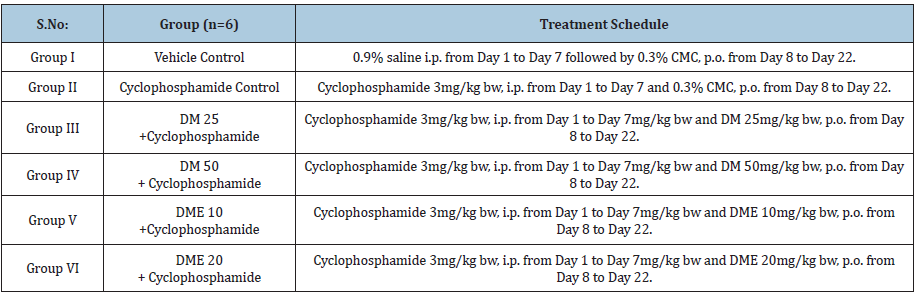
Hematopoietic activity was evaluated cyclophosphamide induced haemotoxicity model in rats [3]. Haemotoxicity was induced by intraperitoneal administration of cyclophosphamide (3mg/kg bw) for 7 consecutive days. Rats were divided into six groups (6 male animals in each group) and treated as Table 1.

Table 1: Treatment for rats.


DM and DME were suspended in 0.3% CMC every day using mortar pestle. The test drugs were orally administered as an aqueous suspension at the maximum volume of 2mL/100gm bw. The control rats were administered with vehicle (i.e., 0.3% CMC) only. Test drugs or vehicle were administered via stainless steel gavage, by calculating the individual dose based on the body weight of each rat.

On day 7, blood samples were collected from the retro-orbital plexus under isoflurane anesthesia and evaluated for various blood parameters using automatic haematology analyser. Hemoglobin (Hb), red blood cell count (RBC), white blood cell count (WBC), hematocrit (HCT) and platelet (PLT) counts were analyzed. Further, blood will be collected on the 22nd day and evaluated for the same hematological parameters.

Statistical analyses

Data from the experiments was expressed as mean ± standard error of mean (SEM). The mean difference between the control and treatment groups was analysed by one-way Analysis of Variance using Graph Pad prism (version 5) Graph Pad Software, Inc., CA, USA. p value<0.05 was considered as statistically significant.

Result

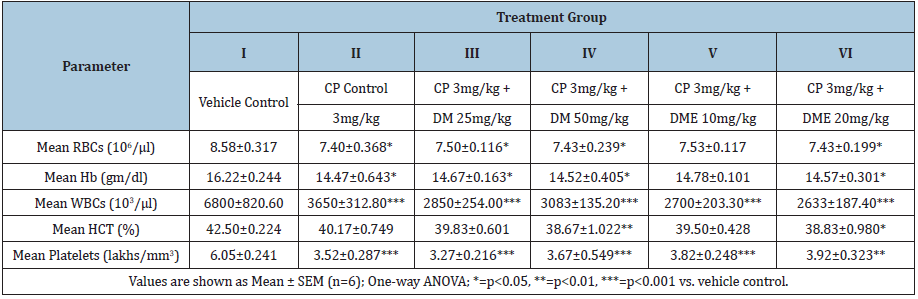
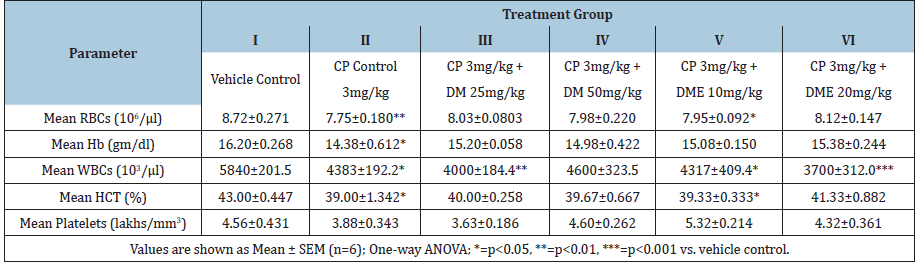
Rats treated with cyclophosphamide 3mg/kg for seven days (group II-VI) showed marked decrease (statistically significant in most of cases; refer to (Table 2) in haematological parameters such as RBC, Hb, WBC, HCT and PLT compared to vehicle control. Haematological perturbations persisted on day- 22 in cyclophosphamide control rats (group-II) and there was a significant reduction in RBC (p<0.01), Hb (p<0.05), WBC (p<0.05), and HCT (p<0.05) compared to vehicle control (Table 3). Treatment with DM at 25 and 50mg/kg bw significantly normalised these haematological parameters and all values were comparable to vehicle control except a significant decrease (p<0.01) in WBC count at DM 25mg/kg bw (4000±184.4 vs. 5840±201.5 of control). DME 10mg/kg treatment normalized Hb and PLT count, however, RBC, WBC and HCT values were still significantly lower (p<0.05) compared to vehicle control. DME 20 mg/kg treatment normalized all hematological parameters except a significant decrease (p<0.001) in WBC count was persisted on day-22 (3700±312.0 vs. 5840±201.5 of control).

Table 2: Effect of Damavi (DM) and its hydroethanolic extract (DME) on haematological parameters in cyclophosphamide- treated albino rats (after 7 days).


Table 3: Effect of Damavi (DM) and its hydroethanolic extract (DME) on haematological parameters in cyclophosphamide- treated albino rats (after 22 days).


Discussion

Present study was carried out to determine erythropoietic activity of traditional Unani formulation DM and its hydroethanolic extract DME. Cyclophosphamide induced model in rats was used to assess the effect of DM and DME on various haematological parameters. Cyclophosphamide induced toxicity model has been routinely used to evaluate the beneficial effect of herbal formulation in blood dyscrasia [3-5]. Cyclophosphamide is an antineoplastic drug that causes myelosuppression due to its metabolites which limits its clinical use [6]. The severity of myelosuppression increases with higher doses of cyclophosphamide. Cyclophosphamide induces myelosuppression by oxidative stress. Traditional medicines have been reported to reverse such changes [7,8].

In the present study, administration of cyclophosphamide at 3mg/kg for seven days (group II-VI) resulted in significant reduction of the RBC, Hb, HCT, WBC and PLT counts on day-7 as compared to vehicle control animals. Treatment with DM at 25 and 50mg/kg from day 8 to day 22 significantly normalised these haematological parameters. Oral administration of DME at the dose of 20mg/kg from day-8 to day-22 restored hematological alterations induced by cyclophosphamide except a significant decrease in WBC count. However, DME 10mg/kg did not effectively reversed haematological parameters induced by cyclophosphamide.

Observed beneficial effect of DM may be exerted by the presence of iron i.e., Hira Kasees (Sulphates of Iron) and atleast partly due to other constituents of DM such as ginger. It is reported that Rainbow trout (Oncorhyncus mykiss) fed with powdered ginger rhizome showed significant immune-stimulatory effect, increasing WBC, haematocrit, RBC count compared with the control group [9]. A recent study reported a significant increase in RBC, WBC, as well as the level of haematocrit and haemoglobin in fish (Cyprinus carpio; common carp) fed with ginger (Zingiber officinale) supplemented diet [10].

R. emodi another ingredient of DM has traditionally been used as diuretic, liver stimulant, purgative/cathartic, stomachic, anticholesterolemic, antitumour, antiseptic, immunomodulatory, as tonic and in menstrual disorders like dysmenorrhoea and menorrhagia (Zargar Hina). Several anthraquinone derivatives including emodin, aloe-emodin, physcion, chrysophanol, rhein, emodin glycoside and chrysophanol glycoside occur as the main chemical constituents [11,12]. R. emodi is reported as antioxidant and bioactivity-guided isolation of roots of R. emodi revealed eugenol, gallic acid, quercetin, rutin, epicatechin, desoxyrhapontigenin, rhapontigenin and mesopsin as major phenolic compounds responsible for the antioxidant activity [13]. Water soluble fraction of alcoholic extract of R. emodi is reported to have nephroprotective effect on all the proximal tubule segments possibly through antioxidant action of the tannins present in the fraction [14]. R. emodi also contains various micro and macro elements such as K, Ca, Fe, Mn, Na, Zn, Co, Li and Cu [15]. Aqueous extract of R. emodi was found to be safe up to 4000mg/kg/day in rats in a repeated dose 90-day oral toxicity study in rats [16]. Reported pharmacological profile of R. emodi including antioxidant potential clearly support the observed beneficial effect of DM in present study. A. arabica, another ingredient of DM is reported as a potent free radical scavenger and hepatoprotective and the polyphenol rich fraction is responsible for free radical scavenging activity [17,18]. Taken together, cumulative synergistic effect of individual ingredients is responsible for observed beneficial effect of this compound Unani formulation in cyclophosphamide induced haemotoxicity in rats. Findings of the study support that DM is a potentially effective therapy to overcome conditions like anaemia and leukocytopenia. Test formulation may be particularly useful as adjuvant therapy to overcome or curtail cyclophosphamideinduced damage during cancer chemotherapy. Further studies are warranted to explore the underlying mechanism DM and DME against cyclophosphamide induced toxicity.

Conclusion

Treatment with DM at 25 and 50mg/kg bw restored the haematological parameters in rats induced by cyclophosphamide. DME effectively restored haematological perturbations only at 20mg/kg bw. Observed effect may be exerted by the presence of iron and other constituents of DM such as flavonoids, terpenoids, and steroids. Present findings validate the indication of this traditional Unani formulation in the management of iron deficiency anaemia and DM could be a potential formulation for erythropoietic activity.

Acknowledgement

The authors would like to record their profound gratitude to Prof. Asim Ali Khan, Director General, Central Council for Research in Unani Medicine, Ministry of AYUSH, Government of India, for providing the necessary infrastructure and facilities. We would like to acknowledge Pathology Laboratory and Pharmacy section staff for their constant support.

References

  1. Anonymous (2018) Compendium of Committee for the Purpose of Control and Supervision of Experiments on Animals (CPCSEA). Ministry of Environment, Forest & Climate Change, Government of India, India.
  2. Reagan SS, Nihal M, Ahmad N (2008) Dose translation from animal to human studies revisited. FASEB J 22(3): 659-661.
  3. Pawar RS, Jain AP, Kashaw SK, Singhai AK (2006) Haematopoietic activity of asteracantha longifolia on cyclophosphamide-induced bone marrow suppression. Indian J Pharm Sci 68(3): 337-340.
  4. Udintsev SN, Schakhov VP (1991) Decrease of cyclophosphamide haematotoxicity by Rhodiola rosea root extract in mice with Ehrlich and Lewis transplantable tumors. Eur J Cancer 27(9): 1182.
  5. Cengiz M (2018) Hematoprotective effect of boron on cyclophosphamide toxicity in rats. Cell Mol Biol 64(5): 62-65.
  6. Ayhanci A, Yaman S, Appak S, Gunes S (2009) Hematoprotective effect of seleno-L-methionine on cyclophosphamide toxicity in rats. Drug Chem Toxicol 32(4): 424-428.
  7. Patra K, Bose S, Sarkar S, Rakshit J, Jana S, et al. (2012) Amelioration of cyclophosphamide induced myelosuppression and oxidative stress by cinnamic acid. Chem Biol Interact 195(3): 231-239.
  8. Meng X, Rong RH, Yu JZ, Keiichi A, Hiroshi K (2014) Effects of carnosine on cyclophosphamide-induced hematopoietic suppression in mice. Am J Chin Med 42(1): 131-142.
  9. Haghighi M, Rohani MS (2013) The effects of powdered ginger rhizome (Zingiber officinale) on haematological and immunological parameters of rainbow trout Oncorhynchus mykiss. Journal of Medicinal Plant and Herbal Therapy Research 1: 8-12.
  10. Mohammadi G, Rashidian G, Hoseinifar SH, Naserabad SS, Doan HV (2020) Ginger (Zingiber officinale) extract affects growth performance, body composition, haematology, serum, and mucosal immune parameters in common carp (Cyprinus carpio). Fish Shellfish Immunol 99: 267-273.
  11. Zargar BA, Masoodi MH, Ahmed B, Ganie SA (2011) Phytoconstituents and therapeutic uses of Rheum emodi ex Meissn. Food Chem 128(3): 585-589.
  12. Rehman H, Begum W, Anjum F, Tabasum H (2014) Rheum emodi (Rhubarb): a fascinating herb. Journal of Pharmacognosy and Phytochemistry 3(2): 89-94.
  13. Singh PP, Ambika, Chauhan SM (2013) Activity-guided isolation of antioxidants from the roots of Rheum emodi. Nat Prod Res 27(10): 946-949.
  14. Alam MM, Javed K, Jafri MA (2005) Effect of Rheum emodi (Revand Hindi) on renal functions in rats. J Ethnopharmacol 96(1-2): 121-125.
  15. Singh P, Negi JS, Rawat MS, Nee PGJ (2010) Quantification of mineral elements of Rheum emodi (Polygonaceae). Biol Trace Elem Res 138(1-3): 293-299.
  16. Ye BG, Feng Y, Wang S (2014) Scientific evaluation of the acute toxicity and 13-week subchronic toxicity of Rheum emodi rhizome extracts in Sprague Dawley rats. Food Chem Toxicol 66: 278-285.
  17. Sundaram R, Mitra SK (2007) Antioxidant activity of ethyl acetate soluble fraction of Acacia arabica bark in rats. Indian J Pharmacol 39(1): 33-38.
  18. Aadil KR, Barapatre A, Rathore N, Pottam S, Jha H (2012) Comparative study of in vitro antioxidant and antidiabetic activity of plant extracts of Acacia arabica, Murraya koeingii, Catharanthus roseus and Rouwolfia serpentina. International Journal of Phytomedicine 4(4): 543-551.

Thursday, February 27, 2020

The Secret Behind the Natural Sex Reversal in Rice Field Eel (Monopterus albus) Remains Unknown- Crimson Publishers

The Secret Behind the Natural Sex Reversal in Rice Field Eel (Monopterus albus) Remains Unknown by Ayah Rebhi Hilles in Advancesin Complementary & Alternative Medicine- Crimson Publishers_ Journal of Alternative and Complementary Medicine


Monopterus albus, the rice field eel (Zuiew), it is under Synbranchidae family; Synbranchiformes order. It lives in the rice fields, swamps, and muddy ponds in different Asian countries. M.albus is a hermaphrodite and undergoes sex reversal naturally Female are intersexes, they have both female and male sex organs with oocytes and spermatocytes in their gonads, and then they become males [1]. The sex reversal of M.albus normally happens after spawning when the eel grows to 35 to 45cm in length [2]. There are many researchers studied the principle of natural sex reversal in M.albus, one of these studies says that this process based on genetic switch-mechanism which the differentiation and maturation of female germ-cells would cease then the epigenesis of male germ-cells and the interstitial Leydig"s cells started, this sexuality shifting from female to male involve the stimulation of some regulators and the mediation of biochemical components and physiological events and environmental factors might also play a role in this series of events [3]. In another study, it has been reported that M.albus undergoes reversal of sex from the female to male genetically which involve the expression of regulatory genes.

For more open access journals in Crimson Publishers please click on link:
https://crimsonpublishersresearch.com/

Wednesday, September 11, 2019

Complementary Treatment of Mood Disturbances in Terminally Ill Oncological Patients with the Aphanizomenon Flos Aquae Extract Klamin®- Crimson Publishers

Complementary Treatment of Mood Disturbances in Terminally Ill Oncological Patients with the Aphanizomenon Flos Aquae Extract Klamin® by Scoglio Stefano in Advances in Complementary & AlternativeMedicine- Crimson Publishers: Journal of Alternative and Complementary Medicine


Klamin® is a proprietary extract of the microalgae Aphanizomenon flos aquae, which concentrates both the phenylethylamine (PEA) naturally contained in the microalgae, and microalgal molecules, such as AFA-phycocyanins and mycosporine-like amino acids (MAAs), which act as physiological MAO-B inhibtors, thus allowing PEA to reach the brain and explete its numerous neuro-modulating activities. Based on this premise, and on previous studies showing the mood enhancing activity of the  extract, we tested its ability to improve the very difficult condition of terminal cancer patients, with special reference to their levels of depression, anxiety and fatigue. The results obtained were positive, in spite of the extreme condition of the patients, with significant improvement of their levels of depression and anxiety, and a lesser but stillrelevant improvement of their level of fatigue. This preliminary study warrants the need for further research on this very relevant subject.

For more open access journals in Crimson Publishers please click on link: https://crimsonpublishers.com/


Friday, August 23, 2019

Rasa Panka (Fundamentals of Dravya Guna Shastra Vijnana)_Crimson Publishers

Rasa Panka (Fundamentals of Dravya Guna Shastra Vijnana) by Venkata N Joshi in Advances in Complementary & Alternative medicine


Rasa' in any subject of life is very interesting and fundamental. Rasa as a basic quality of life begin with the soup of organic chemistry. Carbon, hydrogen, Nitrogen and oxygen along with phosphorus and sulphur consists of 96% of molecules of life in modern chemistry where as rest of minerals and elements are only traces or insignificant to its counterpart of understanding 64 arts of life in combination of emotional Rasa or Bhava, (nava rasa-09) and 63 Vikalpa of Rasa Bheda from 06 rasa etc. (shad anga pradhana shareere shad eva rasaa).

For more open access journals in CrimsonPublishers please click on link: https://crimsonpublishers.com/
For more articles in open access Complementary medicine journals please click on link: https://crimsonpublishers.com/acam/

Wednesday, August 7, 2019

Study of Methanolic Extract of Leaves Calotropis gigantea (L.) As an Anti-Solar- Crimson Publishers


Study of Methanolic Extract of Leaves Calotropis gigantea (L.) As an Anti-Solar by Gharge Varsha Gajanan in Advances in Complementary & Alternative Medicine- Crimson Publishers: Journal of Alternative and Complementary Medicine


Objective: The present study aimed at the phytochemical examination and anti-solar activity of Calotropis gigantea L. (leaf) methonolic extract has more flavonoid content based on this chemical substance photo protective activity was evaluated using UV visible spectrophotometry, where the method is diffused transmittance and the range of UV-visible about 200-400nm.
Methods: The pulverized dried Calotropis gigantea L. leaves were extracted with Methanol using soxhlet apparatus. Methanol extract were filtered & evaporated to dryness. The photo protective activity was evaluated by using UV visible spectrophotometry, where the method it is diffused transmittance and the range of UV-visible about 200-400nm for absorption.
Results: The UV scanning absorption spectra of the extract showed very strong absorption at 0.273A with max at 397nm.
Conclusion: The extract has an ability to absorb in the entire UV range.

For more open access journals in Crimson Publishers please click on link: https://crimsonpublishers.com/
For more articles in Journal of Alternative and Complementary Medicine please click on link: https://crimsonpublishers.com/acam/

Friday, July 5, 2019

Study of Methanolic Extract of Leaves Calotropis gigantea (L.) As an Anti-Solar- Crimson Publishers


Study of Methanolic Extract of Leaves Calotropis gigantea (L.) As an Anti-Solar by Gharge Varsha Gajanan in Advances in Complementary & Alternative Medicine- Crimson Publishers: Journal of Alternative and Complementary Medicine


Objective: The present study aimed at the phytochemical examination and anti-solar activity of Calotropis gigantea L. (leaf) methonolic extract has more flavonoid content based on this chemical substance photo protective activity was evaluated using UV visible spectrophotometry, where the method is diffused transmittance and the range of UV-visible about 200-400nm.
Methods: The pulverized dried Calotropis gigantea L. leaves were extracted with Methanol using soxhlet apparatus. Methanol extract were filtered & evaporated to dryness. The photo protective activity was evaluated by using UV visible spectrophotometry, where the method it is diffused transmittance and the range of UV-visible about 200-400nm for absorption.
Results: The UV scanning absorption spectra of the extract showed very strong absorption at 0.273A with max at 397nm.
Conclusion: The extract has an ability to absorb in the entire UV range.

For more open access journals in Crimson Publishers please click on link: https://crimsonpublishers.com/
For more articles in Journal of Alternative and Complementary Medicine please click on link: https://crimsonpublishers.com/acam/

Friday, June 21, 2019

Perspectives of Complement System in Inflammatory Diseases- Crimson Publishers

Perspectives of Complement System in Inflammatory Diseases by Lalit M Srivastava* in Advances in Complementary & Alternative medicine-Crimson Publishers: Journal of Traditional and Complementary Medicine


The Complement System provides a rapid and efficient means to protect the host from invasive microorganisms. Due to its diverse biological activities, complement is the major mediator of inflammation, a natural response to the host tissue to any injury. Evidences are available to show that complement significantly contributes to the regulation of immune response. Furthermore, the effector functions arising from complement activation carry the potential for harming the host by directly or indirectly mediating inflammatory tissue destruction. Inappropriate or excessive activation of the complement system can lead to harmful, potentially life-threatening consequences due to severe inflammatory destruction. Genetic complement deficiencies or complement depletion have been found to be beneficial in reducing tissue injury of severe complement dependent inflammation.

For more open access journals in Crimson Publishers please click on link: https://crimsonpublishers.com/

Friday, April 12, 2019

Bio-Resources Market Chain Linkages and an Opinion for its Sustainable Utilization in India- Crimson Publishers

Bio-Resources Market Chain Linkages and an Opinion for its Sustainable Utilization in India by Suresh Jagtap in Advances in Complementary & Alternative Medicine: Crimson Publishers- Alternative and Complementary Medicine Journal

Throughout the world, there is large demand of the bioresources and many people are still dependant on it. Medicinal plants are one of the parts of these bio-resources. More than 7,000 species from India are considered as medicinal plants. However, all these species do not have high market demands. Many of them are used by local people and tribal by traditional ways. Few people are well practicing commercial use of medicinal plants for various purposes. As per the reports of Planning Commission in 2000, it has been estimates that, there are over 7,800 manufacturing units in India related to the bio-resources, indicating consistently increasing demand since last decade.
For more open access journals in Crimson Publishers please click on link: https://crimsonpublishers.com/
please click on link: https://crimsonpublishers.com/acam/

Thursday, March 7, 2019

Do We Live in a Sick Society?- journal of alternative medicine research- Crimson Publishers

Do We Live in a Sick Society? by Atul Kumar Mehra* in Advances in Complementary & Alternative medicine

We live in a world where success is an essential part of our life. People do not see us as who we are but how much successful we have been in our life. Do you have a big house, a profession of the year or how good looking you are? This list can go on but the simply hidden idea in fact is that "how much is your worth?" The Society demands us to follow the rules and social obligations which is alright till the point it does not dominate us but when these rules and obligations go out of control in our life then things start to change. Let us look at the sentence "If you are not efficient then you are worth nothing". Although this statement is not common to be heard in everyday life, nevertheless its subtle hidden message repeats almost in every area of our life. Do you think if you do not do your work efficiently in your office then you may be sacked very soon?

For more open access journals in CrimsonPublishers please click on link: https://crimsonpublishers.com/
For more articles in journal of alternativemedicine research please click on link: https://crimsonpublishers.com/acam/  

Friday, February 22, 2019

Preliminary phytochemical analysis and in vivo evaluation of antipyretic effects of methanolicextract of Argyreia pilosa Wight & Arn: Crimson Publishers

Preliminary phytochemical analysis and in vivo evaluation of antipyretic effects of methanolicextract of Argyreia pilosa Wight & Arn by DSNBK Prasanth*, Atla Srinivasa Rao and Rajendra Prasad Yejella in Journal of Alternative and Complementary Medicine

The antipyrexia action of the methanol extract of A. pilosa had been explored utilizing the yeast evoked pyrexia procedure in rabbits. Paracetamol utilized as a positive control as well as negative control group acquired distilled water. Rectal temperatures of all rabbits had been documented instantly prior to the administration of the extract or vehicle or paracetamol as well as again at 30min period for 3h utilizing digital thermometer. The extract had been additionally phytochemically tested with regard to alkaloids, tannins, saponins, flavonoids, cardiac glycosides and phenols. At 400mg/kg dosage the extract revealed considerable decrease in yeast evoked raised temperature when compared with that of standard drug paracetamol where by the extract dose 200mg/kg had been less effective as compared to higher dose (p<0.05). Phytochemical testing demonstrated the existence of flavonoids, alkaloids, tannins, phenols, steroids, acid compounds, glycosides, amino acids, and proteins. This research confirmed that this methanol extract of A. pilosa at a dose of 400mg/kg owns considerable antipyretic outcome against the yeast-induced raised temperature. The antipyretic activity of A. pilosa extract could be due to its secondary metabolites, which probably consist of flavonoids like Rutin and Quercetin; sterols like β-Sitosterol. But, further phytochemical, as well as biological tests, are recommended to determine the other active chemical constituents accountable for the antipyretic activity.

https://crimsonpublishers.com/acam/fulltext/ACAM.000510.php


For more articles in journal of alternative medicine research, follow the URL: https://crimsonpublishers.com/acam/
For more articles in Crimson Publishers, follow the URL: https://crimsonpublishers.com/


Wednesday, September 26, 2018

Homeopathy: Cases and Remedies - Crimson Publishers


Use of Homeopathic medicines in multiple countries has been reported [1]. Better glycemic control in Type 2 Diabetes has been recently reported [2]. Successful treatment of hyperhidrosis of 2 patients with identical symptoms but 2 different constitutions, mercuries solubilize and phosphorus has been reported in the past [3]. In children with Acute Otitis Media (AOM) treated with homeopathic remedy leading to significant pain control was reported from United Kingdom [4]. Good results in treating ADHD with appropriate homeopathic remedy is reported [4]. The purpose of this presentation is to describe a few more cases and Homeopathic remedies.


Visual-cognitive Skills and Physical Qualities in Elite Soccer: Practical Considerations for Training and Return-to-Play Protocols: Crimson Publishers

Visual-cognitive Skills and Physical Qualities in Elite Soccer: Practical Considerations for Training and Return-to-Play Protocols by Lukasz...