Crimson Publishers High Impact Journals

Showing posts with label Journal of Marine Biology. Show all posts

Thursday, September 23, 2021

Vulnerability and Resilience of Tropical Coastal Ecosystems to Ocean Acidification_ Crimson Publishers

 Vulnerability and Resilience of Tropical Coastal Ecosystems to Ocean Acidification by Daniel M Alongi* in Examines in Marine Biology & Oceanography_ Journal of Marine Biology

 

Abstract

Ocean acidification leads to a wide variety of responses from tropical coastal ecosystems. Coral reefs are most vulnerable with most coral species exhibiting declining calcification rates with decreasing pH and carbonate chemistry parameters. Some corals show resilience to acidification likely due to active physiological regulation of their calcifying fluid. Other calcifying organisms, such as some foraminifera and coccolithophores, exhibit negative responses, whereas some symbiont-bearing calcifiers respond positively, to increasing acidification. Seagrasses and brown macroalgae thrive under acidified conditions, with increasing rates of primary productivity. Some tropical coastal fish species are resilient, and in some species, respond positively, to acidification. Some tropical species show complex, nonlinear responses to declining pH and carbonate chemistry. Factors that influence the ability of a species to adapt to and/or resist acidification include food supply, nutrient availability, temperature, diet, interactions with symbionts and other organisms and species and community diversity. Interactive effects of ocean acidification with other climate change parameters, such as elevated temperature, play an important but poorly understood role in determining the resilience and vulnerability of tropical coastal species, communities and ecosystems. Some short-lived species can undergo acclimation and/or adaptive evolution to increase fitness in the face of acidification. Biota living in tropical estuarine and nearshore environments, such as mangroves, seagrasses and intertidal and subtidal inshore benthos, are unlikely to be significantly affected by future acidification as such environments exhibit very wide variations in water and sediment pH and carbonate chemistry

https://crimsonpublishers.com/eimbo/fulltext/EIMBO.000562.php

Crimson Publishers: https://crimsonpublishers.com/

For more articles in Journal of Marine Biology,
Please click on below link: https://crimsonpublishers.com/eimbo/

Wednesday, July 7, 2021

Maximum Sustainable Yield, Maximum Economic Yield and Sustainability in Fisheries_ Crimson Publishers

 Maximum Sustainable Yield, Maximum Economic Yield and Sustainability in Fisheries by Ernesto A Chávez* in Examines in Marine Biology & Oceanography_ Journal of Marine Biology


Abstract
A brief review of the concept of Maximum Sustainable Yield (MSY) used in fisheries management is discussed. The convenience of assessing the exploited stocks with the aid of simulation is advised, because implies the possibility to analyze the age structure of the fishery in more detail, as compared to the traditional methods of fish stock assessment. Emphasis is given to the use of the MSY as limit reference point because as long as the Fishing Mortality or fishing effort required for that point is kept at lower values, the fishery will have a good chance to be sustainable. A mention of the Maximum Economic Yield is made, proposing its use a target for the management, because it is reached in general with lower F values that for the MSY, and this way keeping the fishery in a healthy condition

https://crimsonpublishers.com/eimbo/fulltext/EIMBO.000561.php

Crimson Publishers: https://crimsonpublishers.com/

For more articles in Journal of Marine Biology,
Please click on below link: https://crimsonpublishers.com/eimbo/
 

Wednesday, April 14, 2021

Segments and Gaps in Tide Gauge Records_ Crimson Publishers

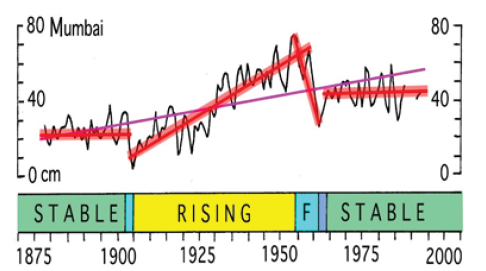
 Segments and Gaps in Tide Gauge Records by Nils Axel Morner* in Examines in Marine Biology & Oceanography_ Journal of Marine Biology


Abstract
The tide-gauge stations all over the globe frequently include gaps, earthquake deformations of reference level, damages of stations and re-locations of sites. In meaningful reconstruction of past sea level change all such structures must be handled with great care. In the original databases of PSMSL and NOAA they are ignored, invalidating meaningful long-term mean trend analyses

The word “segment” in sea level analyses has been differently used. Mörner [1-3] used it to denote segments of sea level changes that had to be characterized individually-in contrast to linear trends ignoring the observational records. Because tide gauges in Mumbai and in Visakhapatnam located on opposed sites of the Deccan Plateau record the same four-parted segments, I interpreted these segments as records of eustatic changes (Figure 1). Parker [4,5], on the other hand, used segmentation to denote interruptions and gaps in the tide-gauge recording

https://crimsonpublishers.com/eimbo/fulltext/EIMBO.000560.php

Crimson Publishers: https://crimsonpublishers.com/

For more articles in Journal of Marine Biology,

Please click on below link: https://crimsonpublishers.com/eimbo/

Thursday, January 28, 2021

Sustainable Development and Waste Management in Offshore Oil and Gas Drilling and Production Industry_ Crimson Publishers

 Sustainable Development and Waste Management in Offshore Oil and Gas Drilling and Production Industry by O Aboul Dahab* in Examines in Marine Biology & Oceanography_ Journal of Marine Biology


Abstract
The present work summarizes and delineates the sources and types of wastes associated with oil and gas offshore drilling and production industry. The work is prepared using descriptive approach in addition to the information obtained from several site visits to different offshore rigs and platforms belonging to different oil and gas companies working in the Arabian Gulf area during the period from 2002 to 2010. It highlights the importance of developing and implementing waste management plans and actions to optimize the use of oil and gas offshore resources. It also demonstrates the waste management hierarchy which can be applied to minimize the negative impact of the offshore oil and gas industry to help in achieving environmental protection and sustainable development in this highly important economic sector.

Introduction
Sustainable development is development that lasts. A specific concern is that those who enjoy the fruits of economic development today may be making future generations worse off by excessively degrading the earth’s resources and polluting the earth’s environment. The general principle of sustainable development adopted by the World Commission on Environment and Development-that current generation should “meet their needs without compromising the ability of future generations to meet their own needs”-has become widely accepted. In considering what we pass on to future generations, we must take account of the full range of physical, human, and natural capital that will determine their welfare and their bequests to their successors.

Offshore oil drilling and production industry wastes include petroleum hydrocarbons, salt, heavy metals, production chemicals, drilling fluids, produced water, nuclear radiation in addition to air pollutants and acoustic impacts [1]. These wastes have potential negative impact to present and future human welfare therefore they must be managed to achieve sustainable development in this economically important industry.

https://crimsonpublishers.com/eimbo/fulltext/EIMBO.000559.php

Crimson Publishers: https://crimsonpublishers.com/

For more articles in Journal of Marine Biology,
Please click on below link: https://crimsonpublishers.com/eimbo/

Wednesday, October 28, 2020

A Rarely Witnessed Summertime Upwelling Event Northwest Off the Hainan Island _ Crimson Publishers

 A Rarely Witnessed Summertime Upwelling Event Northwest Off the Hainan Island by Aijun* in Examines in Marine Biology & Oceanography_ Journal of Marine Biology


Abstract

A field survey revealed a rare realization of upwelling event in the northwestern Hainan Island (UNWHI) on July 24, 2015. Model experiments suggest that the UNWHI is not locally generated, but can be treated as northward extension of the upwelling southwest off Hainan Island (USWHI) under favorable wind conditions. Therefore, presence of the USWHI is vital for the UNWHI occurrence. Tidal mixing is testified to be the primary driving force for the USWHI, whilst southerly winds plays an essential role in the induction of the UNWHI. Moreover, it is demonstrated that the UNWHI is not a stable, but intermittent coastal upwelling system. Shallow basin of the Beibu Gulf makes the interior circulation vulnerable to local monsoon changes. Given the favorable southerly winds, a cyclonic gyre northwest off Hainan Island will be induced and which, leads to northward coastal current and consequently, the UNWHI is to be formed due to the northward transport of the USWHI. Conversely, the UNWHI vanishes during northerly winds period, because the basin-scale anticyclonic gyre results in a southward current west off the Hainan Island and which, acts to push the upwelled water of the USWHI offshore and away from the northwestern Hainan Island. In addition, our diagnostics indicates that contributions from surface heat fluxes to the UNWHI occurrence is negligible. Besides, it also reminds us that application of a high-frequency, much closer to reality wind field is necessary for the coastal upwelling simulation.

https://crimsonpublishers.com/eimbo/abstract/EIMBO.000558.php

For more articles in Journal of Marine Biology,
Please click on below link: https://crimsonpublishers.com/eimbo/

Visual-cognitive Skills and Physical Qualities in Elite Soccer: Practical Considerations for Training and Return-to-Play Protocols: Crimson Publishers

Visual-cognitive Skills and Physical Qualities in Elite Soccer: Practical Considerations for Training and Return-to-Play Protocols by Lukasz...