Crimson Publishers High Impact Journals

Showing posts with label open access journals in Mining & Mineral Science. Show all posts

Monday, September 7, 2026

Quantification of Free Cyanide (CN-) by Volumetric Analysis in Synthetic Solutions of NaCN: Crimson Publishers

Quantification of Free Cyanide (CN-) by Volumetric Analysis in Synthetic Solutions of NaCN by Ramiro Escudero G in Aspects in Mining & Mineral Science: Peer Reviewed Aspects in Mining & Mineral Science

Abstract

There are at least five standardized methods to determine cyanides in water. These procedures have certain limitations and must be applied according to the type or components in the liquid medium. What is clear is that each step of the method applied must be well understood to avoid introducing errors that could lead to the incorrect quantification of free cyanide in solution. An important application of one of the procedures is in mineral processing, specifically in the quantification of free cyanide in residual solutions, for example, during the leaching of gold ores with cyanide. In this work, unreacted cyanide was quantified with known concentrations of cyanicide elements contained in synthetic solutions (simulating a pregnant residual solution). The free cyanide was quantified by the volumetric method based on the color change of the problem solution upon adding the titration reagent AgNO3. Experimental results show that CN and the metal form the complex Me(CN)x-, and the residual CN-, determined by the colorimetric technique, is satisfactorily quantified with an error of less than 3%; however, it is established that a limitation of this technique is the correct quantification of free cyanide if the CN- is less than 0.001g/l. The correct calculation of cyanide (without reaching saturation) that must be added to ensure the dissolution of all the gold contained in a mineral, avoids cyanide passivation and excessive contamination of groundwater and soils.

Keywords:Cyanidation; Leaching; Cyanicides; Cyanide passivation; Free cyanide

Theory

There is little literature on the subject of standardized procedures applied to determine with some accuracy the cyanide in solution, which does not react after a leaching process, even in mining practice procedures are not applied to establish the amount of cyanide necessary to cyanidate the cyanicide species and the gold contained in a gold-bearing ore. The addition of cyanide is based on empirical decisions. This fact is never associated with phenomena such as cyanide passivation and low gold recoveries [1]. NMX-AA-058-SCFI-2001 [2] and ASTM D2036-09 [3], are documents that describe standard test methods for cyanides in water. These include the quantification of cyanide species after distillation, cyanides amenable to chlorination by difference, weak acid dissociable cyanides and cyanides amenable to chlorination without distillation. Common interferences in the analysis for cyanide include oxidizing agents and sulfides, aldehydes, mainly. Aspects that are not considered in these communications are the sensitivity of the techniques, especially for the relatively high and low concentrations of cyanide in solution, in addition to human errors due to the visual assessment of the person applying the technique. In the case of the dissolution of gold and cyanicide metals contained in a gold-bearing ore, the technique applied to quantify the unreacted (or residual) cyanide is the one mentioned above as weak acid dissociable cyanides, which involves the quantification of free cyanide in solution, by colorimetry.

Procedure for quantifying free cyanide (CN-) by volumetry or colorimetry

The weak acid dissociable cyanides procedure consists of the following steps:
a. Preparation of the titrating reagent (AgNO3) at 0.1 normal,
b. Preparation of the KI reagent at 5% (v/v),
c. Preparation of the solution with cyanide,
d. Titration with silver nitrate,

From (Equation 1), the constant 5.308 x 10⁻⁴ corresponds to the grams of cyanide that are associated with 1ml of AgNO3; in other words, one milliliter of silver nitrate reacts or identifies 5.308 x 10⁻⁴ grams of cyanide, according to the stoichiometric ratio of the following reaction.

Certainly, cyanide in solution can be empirically quantified by constructing calibration curves that relate the silver nitrate “consumed” or added, and the known cyanide added to the solution; that is, the grams of silver nitrate that stoichiometrically correspond to react with one gram of cyanide (98g NaCN/169.86g AgNO3=0.576), for a certain dissolution factor of the sample with cyanide. Clearly, the limitation of this empirical quantification is that it does not consider the saturation factor of the solution with CN.

Difference between empirical and standardized methods

It is clear that the empirical method based on the development of calibration curves does not take into account the grams of silver nitrate contained in one liter of silver nitrate, nor does it consider the dilution factor.

Where the result is the cyanide saturation factor, which is equal to 0.05308g of CN- (free cyanide). This constant is substituted into (Equation 1) and together with the dilution factor, generalizes the equation to determine the cyanide that did not react in solution. In this work, cyanide in solution is quantified using empirical calibration curves and applying the equation proposed by the standardized method, which considers the saturation factor of the solution with cyanide, regardless of the degree of dissolution of the analyzed sample.

Experimental Methodology

Materials and reagents

For the quantification of free cyanide by the volumetric technique, a 25ml burette, 100ml Erlenmeyer flasks, universal support, burette clamp, 500, 100 and 50 milliliters volumetric flasks and a 100 milliliters beaker were used. The chemical reagents used were Silver Nitrate (AgNO3), Sodium Cyanide (NaCN), Sodium Hydroxide (NaOH), Potassium Iodide (KI), distilled water, Au, Ca, Mg, Cu and Fe standards-all the above reagent grades.

Quantification of free cyanide in synthetic solutions without metals

Solutions with known concentrations of CN (0.05 to 0.25g) dissolved in distilled and deionized water were prepared. The pH of each sample was set at 11.5. To quantify the CN in solution, the procedure was applied according to the standards NMX-AA-058- SCFI-2001 and ASTM D2036-09.

Quantification of free cyanide in synthetic solutions with metals

Five cyanicidal elements (Au, Ca, Mg, Cu and Fe) were used to prepare synthetic solutions with known concentrations of these elements (Meadded). The quantification was carried out in unitary and binary synthetic solutions; each determination was carried out in triplicate. In the experiments with unitary solutions, the concentration of metals was set at 50ppm in 50ml of deionized water; in the case of binary solutions, the concentration of gold was maintained at 50ppm in 25ml of deionized water, and the rest of the metals were varied from 200 to 300ppm. The percentage of cyanide associated with metals varied from 0.002 to 0.13 (Metal/CNadded ratio from 0.04 to 5), depending on the cyanide concentration in the synthetic solutions. To prevent the formation of hydrocyanic acid, the pH of the synthetic solutions was kept at 11.5; this also ensures that the cyanide dissociated from NaCN will react with the cyanicide metal.

Identification of CN-metal complexes by UV-Vis technique

Each Metal-CN solution before free cyanide quantification was analyzed using the UV-Vis technique to identify the complex species formed for unitary and binary solutions. UV-Vis Spectroscopy equipment, Perkin Elmer brand, model Lambda BIO Series 24117, was used at 200 to 800nm wavelengths.

Result and Discussion

Results of free CN- quantification, empirically through calibration curves

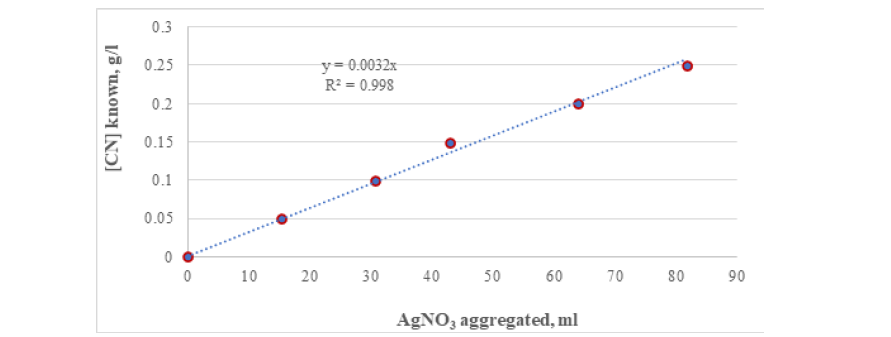
Figure 1 shows the results of CN- quantification by constructing calibration curves, for a dilution factor of 1.0. From the figure above, it is established that the concentration of cyanide in solution can be quantified if the milliliters of silver nitrate added during the colorimetric test are known; this applies to a dissolution factor of 1.0 and the CN range included in this test ([CN] much longer than 0.001g/l). It should be noted that some deviation from linearity is observed for the known minimum and maximum CN values. The equation shown in Figure 1 indicates that the concentration of cyanide in solution can be empirically determined by multiplying the milliliters of silver nitrate by the factor 0.0032. Applying the above relationship to the known values of CN, a certain deviation or error is observed, as the cyanide concentration decreases, as shown in Table 1. This deviation is due to the fact that the relationship between cyanide and silver nitrate is not always linear, this deviation is due to the fact that the relationship between cyanide and silver nitrate is not always linear, as shown in later paragraphs.

Table 1:[CN] known and calculated according to the equation included in Figure 1.


Figure 1:Calibration curve for the data with known concentration of CN in distilled water.

Results of free CN- quantification by volumetry. unitary and binary solutions

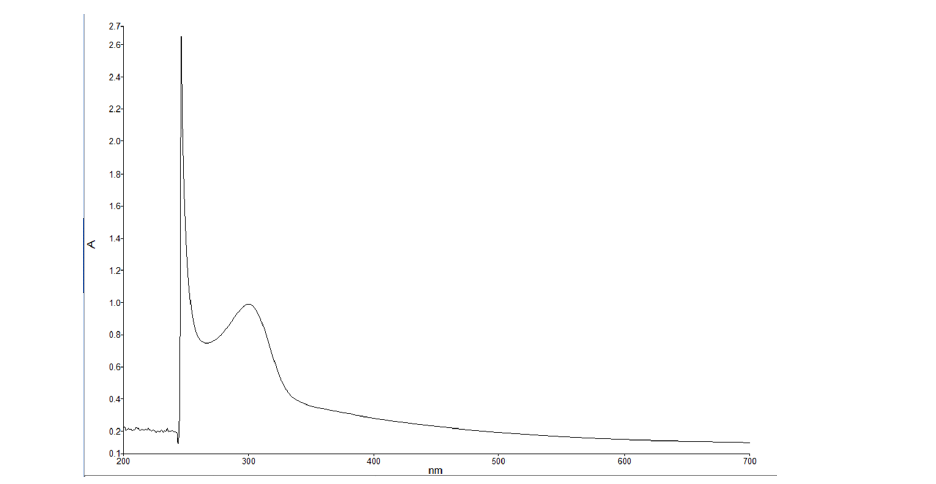
Identification of CN-metal complexes by UV-Vis technique: The solutions analyzed by this technique show evidence of the formation of the Me(CN)− 2 — complexes for the metals Au, Ca, Mg, and Cu, while for Iron, the species Fe(CN)− 6 — was identified. Its characteristic position at the corresponding wavelengths coincides with those reported in the literature [4-10]. An example of the spectra obtained is shown in Figure 2, which corresponds to one of the solutions with Mg. From the identification of the formation of metal complexes with cyanide, it is established that the CN determined by the volumetric technique is the residual or free cyanide, which is the one that did not react with the metals (CN−).

Figure 2:UV-Vis spectrum of the solution with the mixture of CN and Mg in distilled water.

Results of free CN- quantification by volumetry. All solutions

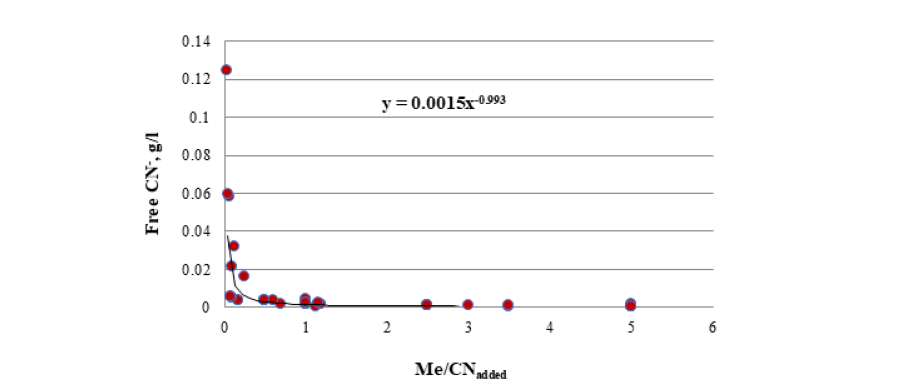
The results of free cyanide quantification by the volumetric technique in both unitary and binary solutions are presented in a previous communication [11]. By including in a single figure all the Me/CNadded ratios for all solutions, unitary and binary, the result is as shown in Figure 3. The above figure shows that all the relationships fit reasonably with the same function, which allows establishing the concentration of free cyanide for any concentration of cyanicidal metal and the cyanide added to the aqueous system. By knowing the concentration of cyanicidal metals in the system, it is possible to determine the quantity of cyanide that must be added so that the free cyanide is less than or close to 0.001g/l, which will help to avoid excess added cyanide, which can promote the passivation of the cyanidation reactions, as well as the contamination of soils and groundwater. Due to the shape of the curve in the relationship shown in Figure 3, it is established that a limitation of this technique is the adequate determination of free cyanide if the CN− is less than 0.001g/l and in any case, the quantification must be carried out in aliquots with a certain dilution factor less than 1.0.

Figure 3:Free CN− quantification results for all Me/CNadded ratios tested in this work.
After applying the standardized method of dissociable cyanides in weak acids to determine free or residual cyanides in water, the following conclusion is derived: All the Me/CNadded ratios included in this research work, reasonably adjusted to the same function that allows establishing the g/l of free cyanide in the residual solution once the cyanide reacts with the cyanicidal metals contained in the reaction system. This conclusion leads to the assertion that it is possible to avoid the excessive addition of cyanide, which inhibits the dissolution of cyanide species, passivating the reactions between cyanide and cyanicide metals contained, for example, in a mineral, as well as the high contamination of groundwater and soil. A limitation of this technique is proposed when the concentration of free cyanide is less than 0.001g/l; it is recommended that the quantification should be carried out in aliquots with a certain dilution factor less than 1.0.

Acknowledgment

Authors deeply thanks the UMSNH for the support received for carrying out this research work.

References

  1. Chumpitaz PH, Rodriguez CE, Andia PG (2022) Significant reduction in cyanide consumption in gold leaching allowed considerable savings in operating costs at the La Arena Mine Processing Plant. Technical Report 2022, Panamerican Silver-La Arena Mine, Canada.
  2. Standard NMX-AA-058-SCFI-2001. Official Gazette of the Federation.
  3. ASTM Designation: D2036-09 (2022) Standard test methods for cyanides in water. US Department of defense. iTeh Standards.
  4. Cobos H, Fabián O, Reyes T, Luis J, García F, et al. (2007) Electrochemical behavior of copper in cyanide solutions. Science and Technology 13(36): 239-244.
  5. Kurowa K, Masaki Y, Koga Y, Deming TJ (2013) Self-Assembly of discrete metal complexes in aqueous solution via block copolypeptide amphiphiles. International Journal of Molecular Sciences 14(1): 2022-2035.
  6. Rawashdeh-Omary MA, Omary MA, Patterson HH (2000) Oligomerization of Au(CN)2- and Ag(CN)2-Ions in solution via ground-state aurophilic and argentophilic. J Am Chem Soc 122(42): 10371-10380.
  7. Monica CV, Avila Y, Mojica R, Avila M, Reguera E (2023) A typical metal‐center coordination in two cyanide‐based coordination polymers. Chemistry Select 8(32).
  8. Gabler N, Hartley J, Frisch G (2017) Voltammetric and spectroscopic study of ferrocene and hexacyanoferrate and the suitability of their redox couples as internal standards in ionic liquids. Physical Chemistry Chemical Physics 19(42): 28841-28852.
  9. Ching Bin K, Te Ling L, Jian Lian C (2018) Capacitively coupled plasma discharge of ionic liquid solutions to synthesize carbon dots as fluorescent sensors. Nanomaterials 8(6):
  10. Barani K, Torkashvand J, Rouhbakhsh H (2023) Characterization of gold and copper complexes in cyanide-clycine systems in cyanide-glycine system by UV.V is spectroscopy. Journal of Chemical Technology and Metallurgy 58(5): 906-912.
  11. Esmeralda Y García A, Ramiro Escudero G, Rosa E Pérez S, Martín Reyes P, Roberto Guerra G (2024) Determination of the appropriate metal/cyanide ratio for the reaction of gold and cyanicidal metals in synthetic solutions quantification of free cyanide by colorimetry. Advances in Mining & Mineral Engineering 1(3): 1-10  

https://crimsonpublishers.com/amms/fulltext/AMMS.000846.php

Publishers: https://crimsonpublishers.com/

For more articles in Aspects in Mining & Mineral Science

Please click on below link: https://crimsonpublishers.com/amms/

Friday, July 22, 2022

Increasing Importance of Using Artificial Intelligence Methods and Regarding Uncertainty in Mining and Tunneling Constructions (Special in Urban Spaces)_Crimson Publishers

Increasing Importance of Using Artificial Intelligence Methods and Regarding Uncertainty in Mining and Tunneling Constructions (Special in Urban Spaces) by Rafie Meraj in Aspects in Mining & Mineral Science_open access journals in Mining & Mineral Science


Opinion

In the 21st century, the mining and tunneling constructions are confronted with high complications in comparison to the past. These complexities are more obvious in urban areas. It’s caused increasing project’s risks.

What factors have caused increasing of these complications?

Increasing effective parameters: With development of technology and population growth in the world, effective parameters on projects have increased more and more. For example, if we want to construct a tunnel under a crowded city, we need to consider tensions caused from buildings, people and automobiles. When we know some these parameters are variable, regarding of them are very tough.

Prediction of ground’s behavior is very difficult: In analysis of ground’s behavior, we are encountered with some uncertainty. The measure of this uncertainty has depended on intact of ground, reducing intact is caused increasing uncertainty. As the city is becoming crowded, required facilities for people are growing continuously. Hence we have to use most spaces that exist underground. For example, under a city, the number of constructions are increasing for various purpose such as the electric power grids, gas grids, municipal water systems, sewage treatment systems, storm drains, and communication services. These constructs aren’t independent from each other. So we have to consider all of them before the beginning of each ones.

Initial cost (before and during constructing a project): Today, unlike in the past, the number of construction contractors have been increased, so a high competitive space has been created to enter into a project's contract. Therefore, contractors have to minimize costs, whereas conditions have complicated and become hard.

Secondary costs and atonements (after happening an accident during a project): The immense costs imposed after failing a project are the most important thing changed in comparison to the past. With the development of communication technologies, public opinion has supervised on progress and failure of projects. Sometimes, the costs caused from a project’s damaging can be more than entire initial costs. Therefore, contractors have to be careful about project’s risks before happening of them.

Why we need to use artificial intelligence?

According to above mentions, uncertainties and complication in mining and tunneling projects are a serious problem so we have to consider them carefully in initial phases. On the other hand, we know it is impossible to analyze ground’s behavior directly. Artificial Intelligence (AI) can be a useful solution. Artificial intelligence includes several various methods such as Artificial Neural Network (ANN), pattern recognizing, image processing. Each of these methods can be effective if we apply them correctly. ANN has been used in prediction and management of underground constructions risks that have been published in various journals. The most important reason why AI is useful is that AI learn relations of among effective parameters from real data. If it is learned correctly, we can confide that complexity and uncertainty have regarded appropriately.

https://crimsonpublishers.com/amms/fulltext/AMMS.000605.php

For more articles in open access journals in Mining & Mineral Science
Please click on below link: https://crimsonpublishers.com/amms/

Monday, May 9, 2022

Applying High Salinity Water in Flotation-A Review_Crimson Publishers

Applying High Salinity Water in Flotation-A Review by Jinhong Zhang in  Aspects in Mining & Mineral Science_open access journals in Mining & Mineral Science


Abstract

The paper reviewed the application of high salinity water in flotation. The materials, of which flotation process high salinity water was use, were classified as four different categories, i.e., ions, soluble salt minerals, coal and sulfide. The mechanism of high salinity’s impact on flotation was also summarized.

Keywords: Mining; Salinity; Trace metals; Salt minerals; Flotation

Introduction

In mining industry, flotation consumes a large amount of fresh water, in spite of the fact that a portion of process water is recycled. Superficially it seems that there is no need to use fresh water for flotation because during flotation, water is mixed with rock which are “dirty”. This raises the logical question whether low quality water, such as river water, reclaimed water and high salinity water (sea water and groundwater), can be used for flotation with no decrease in the efficiency of the process. The present review will focus on the application of high salinity water in flotation. In general, the flotation process using high salinity water can be classified as the following different categories:

Flotation of trace heavy metal species in sea water

Some trace elements, for example, vanadium, selenium and indium and so on, are believed to play a role in the marine biosphere. However, the significance and involvement of these trace heavy elements is not clear yet. Starting from 1970’s, froth flotation began to be applied in analytical chemistry in the separation of a variety of trace ionic species in sea water to quantify these trace metals. The adsorption salt flotation technique was applied for the separation of vanadium and selenium from sea water [1,2]. Sonawane et al. [3] surveyed various surfactants for the flotation of iron (III), aluminum and indium hydroxide collector precipitates for concentrating trace heavy metals in sea water. It was recommended that a 1:3 mixture of sodium oleate and sodium dodecylsulfate gave stable foam-layer formation, which was believed to be essential to salt flotation and therefore a complete flotation. Cabezon et al. [4] used octadecyl amine as collector and Ferric hydroxide as co-precipitant to simultaneously separate copper, cadmium and cobalt from sea water by co-flotation.

Basically, specific cationic or anionic surfactant, called “collector”, was added into sea water and the collector will adsorb on the trace species and render the surface hydrophobic. The hydrophobized trace metal species will attach to bubbles in sea water and rise up forming foam layer for a further removal. Usually, anionic collector is chosen from sodium oleate and sodium alkyl sulfate; while cationic collector is alkyl amine. MIBC is a common frother. Because of the very high recoveries of the trace species based on spiked sea water samples, this pre-concentration by flotation has the advantages of being fast, simple and accurate over the classical techniques such as co-precipitation, co-crystallization and ion-exchange, which have been employed to pre-concentrate trace metals in sea waters.

Flotation of soluble salt minerals (potash, trona and borax) in saturated saline water

Potash is very important for the growth of plants and it is generally used as fertilizer in agriculture. Sylvite, the most important potash mineral, is abundant in saline lake deposits. The water soluble potash mineral has to be separated from other soluble salt mineral, such as halite and so on, before being further processed and made into fertilizer [5]. Historically, flotation process was first applied in 1940’s for the separation of two water soluble minerals, sylvite (KCl) and halite (NaCl), in their own saturated brine water and this event represented a milestone in the development of the flotation process. Now separation of watersoluble minerals by flotation is the most important present-day method of potash ore processing. In practice, both normal flotation and reverse flotation have been used for the separation of sylvite from halite [6]. Collector can be chosen from either cationic alkyl amine surfactant or anionic alkyl sulfate surfactant. Frother and conditioning agent are typically required for high flotation recovery and efficiency. Recently, a complete review work was published by Ozdemir et al. [7] showing that the ion specificity effect is the most important factor influencing salt flotation. In the specific work, the measurement such as solution viscosity, surface tension, bubbleparticle attachment time, contact angle, atomic force microscopy, sum frequency generation vibrational spectroscopy and molecular dynamics simulation have been used to study the air-solution and solid-solution interfacial phenomena.

Flotation of coal using sea water

The reason that sea water has been applied for coal flotation is mainly because in 1920 some coals were reported to be readily floated in sea water without the addition of reagents (collector and frother). In 1930’s, the flotation of coal using sea water was further investigated by Russian researchers [8]. The technique was later developed and called salt flotation, in which a high concentration of inorganic electrolyte is employed. Many studies have been carried out since then and it has been proposed that salt flotation is generally applied for naturally hydrophobic minerals, particularly for coal. Klassen and Vlasova [9] studied the flotation of coals of different rank in the presence of NaCl and reported that sea water can be a good self-frothing media in coal flotation. Results showed that high-rank coals can be successfully treated in NaCl solutions; however, flotation of the low-rank coals required the addition of hydrocarbons (petroleum). Fuerstenau et al. [10] studied the effect of surface functional groups on the salt flotation of coal and claimed that salt flotation was sensitive to coal functional group and it failed completely for heavily oxidized coal. They proposed that flotation rate increased substantially with increasing salt concentration, although the position of the maximum in floatability with respect to pH did not change. It was reported that increasing electrolyte concentration would introduce a more rapid thinning and rupturing of the film between particle and bubble. Yoon and Sabey [11] reported that salt flotation was better than conventional flotation by introducing faster flotation kinetics and a higher separation efficiency of removing ash from bituminous coal. Results showed that the frothability of salt solution increased with increasing salt concentration and divalent cations salts gave the best flotation results.

Li and Somasundaran [12-14] studied the effect of NaCl on coal flotation using a modified Hallimond tube and Zeta potential meter to delineate the role of the electrostatic interaction between bubbles and particles. It was reported that, at low salt concentrations and high salt concentrations, flotation exhibited showed different behavior. Botula et al. [15] studied the effect of saline water on coal flotation and reported that no statistically significant effect of water salinity (salt concentration or composition) was observed. Iskra et al. [16] investigated the effect of mine water salinity on flotation of coal slurries from Budryk Mine and reported that water salinity improves flotation kinetics and reduces reagents consumption. Hampton and Nguyen [17] studied the accumulation of dissolved gases at hydrophobic surfaces in water and NaCl solutions and discussed its implications for coal flotation in saline water in terms of attraction between hydrophobic surfaces in water, bubble/particle attachment and hydrophobic coagulation between particles. They reported that NaCl concentration (up to 1M) had a negligible influence on the geometry and population of pre-existing nanobubbles. Ozdemir et al. [18] focused on the surface chemistry aspects of coal flotation in bore water which was frequently used as process water in several flotation plants in Western Australia. Some surface chemistry techniques, such as bubble/particle attachment time experiment, zeta potential measurement, contact angle measurement and Atomic Force Microscopy (AFM) were applied to clarify the effect and mechanism of high salt/electrolyte concentrations.

Flotation of sulfide minerals using high salinity water

High salinity water has been applied for sulfide flotation generally in the arid areas such as Chile and Western Australia, where water is a precious commodity with little or no access sometimes. In practice, the concerns related to sulfide salt flotation are mainly focused on the impact of high salinity on flotation efficiency, the buildup of salt in recycled water and equipment corrosion. Sutulov [19] reported that successful flotation of copper minerals had taken place in Chile using sea water and the common buildup of dissolved mineral salts (Ca, Mg, Na) in recycled water was not a demonstrable problem. Vaughan and Dunne [20] studied the mineralogy and processing characteristics of Archean gold ores from Western Australia in highly saline ground water in the Yilgarn area. It was reported that the saline process water may interfere with processing in a variety of ways. For example, protective coatings were required because of the equipment corrosion problem in plants, arising from mainly the high NaCl content in groundwater. Wellham et al. [21] studied the role of carboxyl methyl cellulose in the flotation of a nickel sulfide transition ore. The hypersaline water used in the flotation plants was reported to make traditional serpentine dispersants ineffective.

Klimpel [22] claimed that sea water could be applied in flotation quite successfully. In addition, the hard water containing high levels of monovalent and divalent ions do not negatively affect the recovery and selectivity of water insoluble uncharged collectors with naturally floatable sulfide minerals. Rhodes and Penna [23] studied the flowsheet for the Sukari gold project, which is in one of the driest deserts in the world, in Egypt. The plant was designed to use sea water, which was pumped from the Red Sea 22km from the mine site, in the process plant grinding, leach and flotation circuits. Actually, a proportion of the water was treated in a reverse osmosis plant to produce fresh water for the gold circuit, mine services and power plant. Peng et al. [24] carried out a research on the flotation of a low grade pentlandite (nickel sulfide) ore containing large amounts of serpentine minerals from Mt. Keith in Western Australia using high salinity process water. Moreno et al. [25] reported the use of seawater as process water at Las Luces copper–molybdenum beneficiation plant in Taltal (Chile). In Las Luces plant, seawater is mixed with tailings pond water and used in the grinding and flotation circuits. It was claimed that the plant had successfully used seawater for many years without the use of any fresh water and a loss of water to evaporation could be a problem. In Chile, [26] which is located in the Atacama Desert, one of the driest desert in the world, at an elevation of 2100m above sea level became the first large-scale copper mine to only raw sea water in flotation.

Mechanism of High Salinity’s Impact on Flotation

The difference between high salinity water and fresh water is mainly because the ionic strength in the former is much higher. Many investigations have been carried out to study the impact of high ionic strength on coal flotation in inorganic electrolyte solutions and several theories have been proposed. Firstly, the inorganic electrolytes can prevent bubble coalescence which leads to reduced bubble size and increased population. These will further increase bubble-particle attachment efficiency and froth stability, hence flotation efficiency [11,27,28]. Secondly, it was proposed that high ionic strength may compress the electrical double layer (EDL) between bubbles and particles and therefore reduce the zeta potential of both bubbles and particles. The theory was supported by some experiment results showing that the flotation recovery achieved a maximum at a minimum zeta potential [10,11]. Thirdly, Klassen and Mokrousov [29] suggested that the inorganic electrolytes reduced the surface hydration of coal and destabilized the hydrated layers surrounding coal, which made the coal more hydrophobic and enhanced the bubble-particle attachment. However, this mechanism broke down in the case of naturally hydrophilic minerals, the flotation of which was not improved by the presence of high ionic strength.

Summary

The above review of using high salinity water in flotation shows that: 1) technically saline water can substitute for fresh water and be used in a large scale in flotation even without desalinization; 2) the impact of high salinity’s impact on flotation could be multifold. For some flotation systems, high salinity water increases flotation performance; while it does reversely in other cases; 3) the mechanism of high salinity’s impact on flotation depends on various conditions, such as ore type, ions species, ionic strength, pH, surface potential and others. As such, in practice, high salinity water may impact flotation in a complex way and it requires a systemic study for a specific case. An important prerequisite for this is that the chemistry of high salinity water will not evidently decrease flotation recovery and efficiency.

References

  1. Hagadone M, Zeitlin H (1976) The separation of vanadium from sea water by adsorption colloid flotation. Analytica Chimica Acta 86: 289-292.
  2. Tzeng JH, Zeitlin H (1978) The separation of selenium from sea water by adsorption colloid flotation. Analytica Chimica Acta 101(1): 71-77.
  3. Sonawane NJ, Hiraide M, Mizuike A (1983) Combined use of two surfactants for flotation of metal hydroxide precipitates in sea water. Analytica Chimica Acta 149: 359-362.
  4. Cabezon LM, Caballero M, Cela R, Perez JA (1984) Simultaneous separation of copper, cadmium and cobalt from seawater by flotation with amine and ferric hydroxide as collectors. Talanta 31(8): 597-602.
  5. DeVaney FD (1999) Flotation. Industrial and Engineering Chemistry 38(1).
  6. Titkov S, Panteleeva N, Chistyakov Pimkina AL, Mikhaylova I (2000) Studies of surface and sorption behavior of saline and clay carbonate minerals in electrolytes. Proceedings of the XXI International Mineral Processing Congress, Rome, Italy. pp. 23-27.
  7. Ozdemir O, Du H, Karakashev S, Nguyen A, Celik MS, et al. (2011) Understanding the role of ion interactions in soluble salt flotation with alkylammonium and alkylsulfate collectors. Advances in Colloid and Interface Science 163(1): 1-22.
  8. Luisenko PD (1935) Enrichment of the long-flame coals of LIS sitchansk by flotation with salts. Coke and Chem 5(10): 40-46.
  9. Klassen VI, Vlasova NS (1963) The effect of reagents in coal flotation. J of Mining Science 3(5): 504-510.
  10. Fuerstenau DW, Rosenbaum JM, Laskowski J (1983) Effect of surface functional groups on the flotation of coal. Colloid and Surfaces 8(2): 153-173.
  11. Yoon RH, Sabey JB (1989) Coal flotation in inorganic salt solution. In: Botsaris GD, Glazman YM (Eds.), Interfacial phenomena in Coal Technology. Marcel Dekker, New York. pp. 87-114.
  12. Li C, Somasundaran P (1991) Reversal of bubble charge in multivalent inorganic salt solutions-effect of magnesium. J Colloid Interface Sci 146(1): 215-218.
  13. Li C, Somasundaran P (1992) Effect of NaCl on coal flotation. SME Annual Meeting Phoenix, Arizona, USA. pp. 24-27.
  14. Li C, Somasundaran P (1993) Role of electrical double layer forces and hydrophobicity in coal flotation in sodium chloride solutions. Energy Fuels 7(2): 244-248.
  15. Botula J, Repka V (1996) Effect of saline water on flotation processing of coal. Uhli-Rudy-Geol Pruzkum 3(1): 13-14.
  16. Iskra J (1996) Effect of mine water salinity on flotation of coal slurries from the Budryk mine. Zesz Nauk Politech Slask Gom 231: 237-252.
  17. Hampton MA, Nguyen AV (2009) Accumulation of dissolved gases at hydrophobic surfaces in water and sodium chloride solutions: Implications for coal flotation. Minerals Engineering 22(9-10): 786-792.
  18. Ozdemir O, Taran E, Hampton MA, Karakashev SI, Nguyen AV (2009) Surface chemistry aspects of coal flotation in bore water. Int J Miner Process 92(3-4): 177-183.
  19. Sutulov A (1963) Flotation of minerals. Chile. pp. 124-126.
  20. Vaughan JP, Dunne RC (1987) Mineralogy and processing characters of Archen gold ores from Western Australia. Gold Mining, Australia. pp. 241-256.
  21. Wellham EJ, Elber I, Yan DS (1992) The role of carboxyl methyl cellulose in the flotation of a nickel sulphide transition ore. Miner Eng 5(3-5): 381-395.
  22. Klimpel R (1999) A review of sulfide mineral collector practice. In: Parekh BK, Miller JD (Eds.), Advances in Flotation Technology, USA.
  23. Rhodes M, Penna F (2009) Flowsheet development for the Sukari gold project in Egypt. World Gold Conference 2009. The Southern African Institute of Mining and Metallurgy, Australia. pp. 279-286.
  24. Peng Y, Seaman D (2011) The flotation of slime-fine fractions of Mt. Keith pentlandite ore in de-ionised and saline water. Minerals Engineering 24(5): 479-481.
  25. Moreno PA, Aral H, Cuevas J, Monardes A, Adaro M, et al. (2011) The use of seawater as process water at Las Luces copper-molybdenum beneficiation plant in Taltal (Chile). Minerals Engineering, Chile.
  26. Esperanza mine (2011) CESCO: Chile Antofagasta's Esperanza Gets Creative with Seawater.
  27. Yoon RH (1982) Flotation of coal using micro-bubbles and inorganic salts. Min Congr J 68(12): 76-80.
  28. Paulson O, Pugh RJ (1996) Flotation of inherently hydrophobic particles in aqueous solutions of inorganic electrolytes. Langmuir 12(20): 4808-4813.
  29. Klassen VI, Mokrousov VA (1963) An introduction to the theory of flotation. In: Leja J, Poling GW (Eds.), Butterworths, London.

For more articles in open access journals in Mining & Mineral Science
Please click on below link: https://crimsonpublishers.com/amms/

Thursday, December 2, 2021

Towards Green Cements: The Metakaolin Route_Crimson Publishers

 Towards Green Cements: The Metakaolin Route by Henry F Meier in Aspects in Mining & Mineral Science_Open access journals in Mining & Mineral Science


Opinion

One of the main challenges to be faced by the industry in this 21st century is the drastic reduction of its gaseous emissions, whether with the presence of particulate matter or substances that are aggressive to the environment. Both are problems found in the cement industry, which is responsible for up to 7% of carbon dioxide emissions produced by industrial human activity, which leads to the greenhouse effect [1]. This is due to two reasons: the first is that the raw material used for the production of clinker in rotary cement kilns is the limestone that undergoes a high temperature decarbonation reaction, with the transformation of carbonates into oxides and CO2 emission in the gaseous form, releasing fossilized carbon that had been purged from the natural carbon cycle in the atmosphere; the second is that the thermal energy used to supply the energy demand for the reactions comes from the use of solid fossil fuels such as petroleum coke. The CO2 average rate production is of the order of 800 kg of CO2/ton of cement, due to the calcination of limestone. Of this amount, 50% comes from decarbonation and 40% from burning fossil fuels to supply energy demand. Efforts have been made to reduce emission rates, such as the use of biofuels, increase of clays in the raw material, and absorption of CO2 emissions. An alternative that has been evaluated is the use of pozzolanic clays in a reactive state as supplementary material [2], a technology that has been developed but which is not yet widely applied in the cement industry. The calcination of clays promotes the dehydroxylation of the molecules by the action of heat, forming only water vapor as a gaseous emission and an amorphous material called metakaolin. Metakaolin is highly reactive with water and forms a higher concentration of porous, low density spheres, with high absorption capacity and large surface area, suitable for clinker replacement. Metakaolin is known as low carbon cement, or “green cement”, and can be used as a substitute or as an additive to conventional cement since it has better pozzolanic properties than Portland cement, such as [3]: increased resistance to compression and flexion, chemical attack and durability; the decrease in alkali-silica permeability and reactivity; facilitating the application of concrete, improves finish and appearance. In addition to the precursor kaolin, metakaolin can be obtained from recycled paper sludge, thus responding to more than one environmental appeal.

The calcination process of clays can be carried out in different ways, but the most promising is the “flash” calcination, in which the particulate solid kaolin is exposed to a gas stream at high temperature (500-900 °C) and in an adequate proportion for a few seconds, being cooled quickly afterwards [4,5]. Another way of production is through slow calcination in rotary kilns or in fixed beds (“soak calcination”), which requires residence times in the order of tens of minutes to hours due to low heating rates. San Nicolas et al. [5] noted that the metakaolin produced by the “flash” process, with a temperature between 600 and 700 °C, contained a greater amount of spherical particles compared to that produced in a rotary kiln, which made it easier to apply, in addition to finding no significant difference regarding the pozzolanic activity of the products of each process. Claverie et al. [6] also found that the spherical particles were composed of gases and aluminosilicates with varied crystallinity. This heterogeneity was credited to the temperature gradient and the cyclonic movement of the flow in the calciner. By controlling the particles residence time in the calciner, different degrees of reactivity and dehydroxylation can be obtained. However, when exposed to temperatures greater than 900 °C and/or maintained for an excessive period in the calciner, metakaolin changes to other physical forms such as amorphous silica, mullite and glassy/crystalline silica. These latter compounds are no longer interesting as supplementary material, since they lose pozzolanic activity. Since kaolin calcination requires greater control of the mass ratio between hot gases and kaolin, temperature and residence time of the particles, its large-scale production becomes an engineering challenge. If this process is not well controlled, metakaolin can be transformed into undesirable materials. Still, the optimum temperature and calcination period are not yet known [7]. Investigations of the thermofluidodynamics of this reaction system, therefore, are fundamental for the deep understanding of calcination and, consequently, to advance in the development of this technology. However, greater attention has been paid to mathematical models for calcination of limestone, a fundamental raw material for cement, than for kaolin calcination. Possibly the first attempt in this direction was made by Salvador and Davies [8,9]. Teklay et al. [9] proposed a mathematical model for the chemical and physical conversions that occur in the kaolinitic clay particle, and subsequently evaluated the “flash” calcination in a pilot-scale reactor [9].

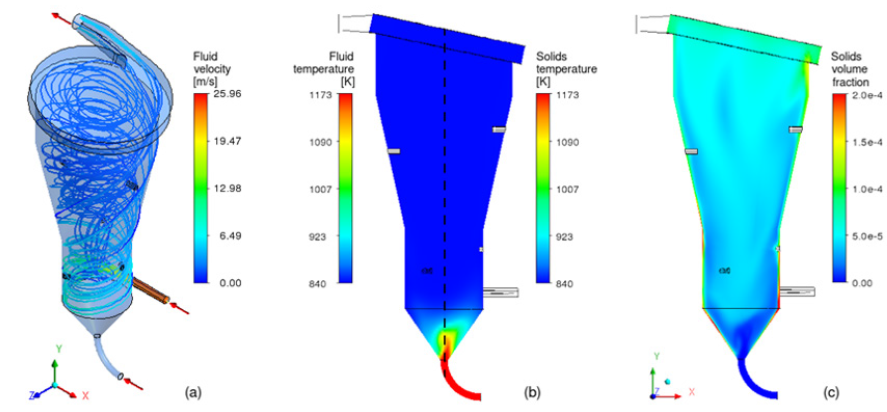
Numerous experimental studies of dehydroxylation in a rapid reaction system (“flash”) with clays from different regions of Brazil have been carried out, showing that the process is technically and economically viable. Given that experimental tests have already been carried out successfully on a pilot scale, the transfer of this knowledge to industrial application remains, which requires a methodology adjusted for the complex calcination of kaolin in large scale. The proper investigations of reactors with large geometric proportions can be done using the Computational Fluid Dynamics (CFD) technique. In this sense, simulations are performed with a reactive multiphase model, capable of predicting in detail the pressure, velocity, temperature and chemical species concentration under reactive and turbulent conditions with heat and mass transfer. (Figure 1) presents simulation results of the rotary flow of kaolin and hot gases in an innovative configuration of calciner, in which a good thermal exchange is observed between the phases with the upward transport. Combining CFD simulations with optimization techniques, it is possible to define the geometric details of the reactor in order to guarantee an adequate configuration to leave the scale of the pilot plant where kg/h are produced, for the industrial prototype scale with ton/h production of metakaolin. Metakaolin appears as an attractive and viable alternative for cement production, as it is capable of reducing up to 50% of CO2 emissions without drastic changes in the industrial park [10,11]. Numerical simulations can be used to evaluate the scale-up of the metakaolin production process, bringing it to high-tech status, hence facilitating the mitigation of CO2 emissions by replacing limestone calcination with the production of low carbon cement.

Figure 1: Results from numerical simulation of kaolin in a calciner (a) Fluid stream lines, (b) Kaolin temperature and (c) Volume fraction.


Acknowledgement

The authors gratefully acknowledge the financial support from FAPESC (code 2018TR1532) for this research.

References

  1. Worrell E, Price L, Martin N, Hendriks C, Meida LO (2001) Carbon dioxide emissions from the global cement industry. Annual Review of Environment and Resources 26: 303-329.
  2. Bridson D, Daavies T, Harrison D (1985) Properties of flash-calcined kaolinite. Clays and Clay Minerals 33(3): 258-260.
  3. Teklay A, Yin C, Rosendahl L, Bojer M (2014) Calcination of kaolinite clay particles for cement production: A modeling study. Cement and Concrete Research 61-62: 11-19.
  4. Salvador S, Pons O (2000) A semi-mobile flash dryer/calciner unit to manufacture pozzolana from raw clay soils -application to soil stabilization. Construction and Building Materials 14: 109-117.
  5. San Nicolas R, Cyr M, Escadeillas G (2013) Characteristics and applications of ash metakaolins. Applied Clay Science 83(84): 253-262.
  6. Claverie M, Martin F, Tardy JP, Cyr M, De Parseval P, et al. (2015) Structural and chemical changes in kaolinite caused by flash calcination: Formation of spherical particles. Applied Clay Science 114: 247-255.
  7. Rashad AM (2013) Metakaolin as cementitious material: History, scours, production and composition-A comprehensive overview. Construction and Building Materials 41: 303-318.
  8. Salvador S, Davies TW (1994) Modeling of combined heating and dehydroxylation of kaolinite particles during flash calcination production of metakaolinite. Process Adv Mater 9: 128-135.
  9. Teklay A, Yin C, Rosendahl L, Kohler LL (2015) Experimental and modeling study of flash calcination of kaolinite rich clay particles in a gas suspension calciner. Applied Clay Science 103: 10-19.
  10. Salvador S (1995) Pozzolanic properties of flash-calcined kaolinite: A comparative study with soak-calcined products. Cement and Concrete Research 25(1): 102-112.
  11. Siddique R, Klaus J (2009) Influence of metakaolin on the properties of mortar and concrete: A review. Applied Clay Science 43(3-4): 392-400.

For more articles in open access journals in Mining & Mineral Science
Please click on below link: https://crimsonpublishers.com/amms/

Visual-cognitive Skills and Physical Qualities in Elite Soccer: Practical Considerations for Training and Return-to-Play Protocols: Crimson Publishers

Visual-cognitive Skills and Physical Qualities in Elite Soccer: Practical Considerations for Training and Return-to-Play Protocols by Lukasz...