Crimson Publishers High Impact Journals

Showing posts with label Gastroenterology Medicine & Research. Show all posts

Wednesday, July 27, 2022

Testicular Cancer and Microbiota_Crimson Publishers

Testicular Cancer and Microbiota by Álvaro Zamudio Tiburcio in Gastroenterology Medicine & Research_Gastroenterology Medicine & Research


Abstract

We analized a Male with 33 years old. 2003 is detected Seminoma of the left testis, which is removed. Twenty sessions of radiotherapy are administered and observed for 5 years. In 2008, right testicle was removed, and prostheses were placed. Classic teratoma-endodermal seminoma is diagnosed. 2011, AFP control study (400ng/mL), with lessions in the iliac and Cavo-aortic arteries. In laparotomy, the necrotic is removed. New Chemo. Retroperitoneal process appears and is kept under observation for one year, without elevated markers. 2013 detect AFP (69ng/mL). They operate it by removing the metastases again. The AFP rises and is operated again in 2016. In 2017 ACE is 100 (ng/mL). With intra-aortic metastases. They operate it. 2018, the necrosis is removed again. “Last surgery.” Intestinal Microbiota Transplantation (IMT) is carried out on March 21, 2019.

Keywords: Testicular cancer; Intestinal Microbiota Transplantation (IMT); Intestinal Microbiota (IM)

Introduction

33-year-old Male with left testicle removed cancer. Classic seminoma is diagnosed. Provide radiotherapy and decided to observe it for 5 years. Operate on 6 occasions, removing the second testicle and numerous intra-abdominal metastases. Intestinal Microbiota Transplant is carried out Anxiety dropped from 22 to 8 points [1], He looks better. The joints hurt, allergic pictures and in tolerates all foods, finish. IBS with stool formed. (He says that he had not evacuated solid for years).

Diagnosis

A. Retroperitoneal cancer secondary to classic left seminoma, removed

B. Seminoma and classic endodermal left teratoma (removed)

C. Five times retroperitoneal metastases (operated)

D. Anxiety 22 points. Hamilton Scale

E. Insufficient weight (BMI 17)

F. IBS, diarrhea variety

G. Multi-allergic

Cites in a month and then in 5 months and looks better. The joints hurt 70% less. The allergic pictures to dust and pollen, decreased 70%. Tolerates all foods, including mole, spicy candy, guacamole and beer. IBS with stool formed. (He says that he had not evacuated solid for years). Increased 200 grams. Abdominal diameter 76 centimeters, Blood Pressure 102/65, Pulse 78X´. Temperature 98.0600° F. Breathes 18X´ Tolerated Lactobacillus reuteri (Pylopass). Inulin 0.453Gm. One a day. After breakfast: One month.

Comments

The Intestinal Microbiota Transplant (IMT) is a methodology that can be used in patients affected by Cancer, due to its good results. It has been suggested that the Intestinal Microbiota can modulate the effectiveness of cancer therapies, especially immunotherapy [2]. Although it has been shown that the microbiota may have no actions, decrease or increase in susceptibility to cancer. It turns out that investigating these effects, as well as applying knowledge to try to remedy these frequent illnesses, is currently an extraordinarily interesting fact [3]. Thus, we see that in addition to the impact that the microbiota has on cancer, the one that has some probiotic of the Lactobacillus rhamnoses type is added [4].

One of the most significant aspects that must be taken into account in cancer patients is whether they are immunocompromised or not. Therefore, IMT we suggest, is carried out on that waiting measure, when the immune compromise is minimal. Since in case of performing IMT in patients with great immune compromise, it can fall into the complex terrain of infectious processes [5].

Now, where is the mind-heart link with cancermicrobiota?

The gut-microbiota-brain axis has already been described and more articles are observed in this regard, in the world literature, where it is pointed out, that in this axis, there is two-way communication, between the brain and the intestine, through biochemical signals. That is this two-way communication, which perfectly coordinates the immunological status, allows the microbiota to act, once determined-between both components - the actions to be followed and, thus, it is seen that the immune system responds favorably to this communication, allowing clinical improvements, not only in testicular cancer, but in most cancers, as well as in another series of conditions of different kinds, highlighting those generated in the systems, Gastrointestinal, dermatological, psychiatric, neurological, endocrinological and others [6-9]. Where the mind-heart link with cancer-microbiota lies, because in the gut-microbiota-brain axis, already described.

Conflicts of Interest

The authors declare that they do not have affiliation or participation in organizations with financial interests.

Ethical Approval

This report does not contain any study with human or animal subjects carried out by the authors.

Informed Consent

The authors obtained informed written consent from the patient, in order to develop this article.

References

  1. Hamilton M (1959) The assessment of anxiety states by rating. Br J Med Psychol 32(1): 50-55.
  2. Chen D, Wu J, Jin D, Wang B, Cao H (2018) Fecal microbiota transplantation in cancer management: Current status and perspectives. Int J Cancer 145(8): 2021-2031.
  3. Garret WS (2015) Cancer and the microbiota. Science 348(6230): 80-86.
  4. Vivarelli S, Salemi R, Candido S, Falzone L, Santagati M, et al. (2019) Gut microbiota and cancer: From pathogenesis to therapy. Cancers (Basel) 11(1): E38.
  5. Wardill HR, Secombe KR, Bryant RV, Hazenberg MD, Costello SP (2019) Adjuntive fecal microbiota transplantation in supportive oncology: Emerging indications and considerations in immunocompromised patients. E Bio Medicine 44: 730-740.
  6. Dinan TG, Cryan JF (2017) Brain gut microbiota axis and mental health. Psychosom Med 79(8): 820-926.
  7. Hong XW, Ping YW (2016) Gut microbiota brain Axis. Chin Med J (Eng) 129(19): 2373-2380.
  8. Tiburcio ÁZ, Ruiz HB, López RPA (2019) Microbiota disease. Open J Bac 3(1): 008-010.
  9. Molina TC, Rodriguez AM, Roman P, Snachez LN, Cardona D (2019) Stress and the gut microbiota brain axis. Behav Phamacol 30(2-3): 187-200.
For more articles in Gastroenterology Medicine & Research
Please click on below link: https://crimsonpublishers.com/gmr/

Tuesday, December 7, 2021

Young Rats and Negative Effects of Low-Alcohol and Energy Drinks_Crimson Publishers

 Young Rats and Negative Effects of Low-Alcohol and Energy Drinks by Trubitsyna IE in Gastroenterology Medicine & Research_Gastroenterology Medicine & Research


Abstract

Recently, low-alcohol and energy drinks have become widespread among young people, which are considered “harmless drinks “among them. However, young people get used to these drinks and cannot do without them, the dose of consumption increases. Therefore, it requires study to establish the role of the studied beverages in organizational and mental disorders. The article convincingly proves the causal relationship between alcohol and damage to internal organs and mental state in rats.

Keywords: Low-alcohol and energy drinks; Liver; Kidneys; Lungs; Heart; Psyche

Introduction

The behavior of any living creature is aimed at satisfying a particular need-biological, social. Need can be defined as an objective need for something, for this it must become subjective, normally perceived by the nervous system of the animal, and encourage him to act on its satisfaction, motivate both the animal and man to certain actions. In animals, the main biological motivations are food, drinking, sexual and self-preservation. The emergence of several motivations that require a choice, determine the highest priority. In animals, this is solved by an innate hierarchy of needs-the main one is self-preservation, which always prevails over the rest-when life is threatened, sexual, drinking or eating decreases. When drinking alcoholic beverages, the motivation for self-preservation is suppressed instantly and the craving for alcohol comes out in the first place, animals struggle for being at the drinker with an alcoholic beverage [1,2].

Purpose

To study the behavior of young rats in the use of low-alcohol (LA) and energy drinks (E).

Material and Methods

Studies were conducted on “young” white rats of the Wistar line, weighing 100-120g-15- 16 years by human standards. Three groups were identified: control (C)- animals had free access to water and food. Experimental groups (O) – O1 animals had free access to water and food. Additionally, a drinking bow 1.) with E “Red Bull”. 2.) was added, O2 - drinking bowl with LA “Black Russian” was added. Each group has 5 rats. Autopsy of animals after 14 and 45 days. The damage index (PI) is the number of injuries by the number of animals. In addition to animals, University teachers observed the behavior of young people (students) who used E and LA.

Results and Discussion

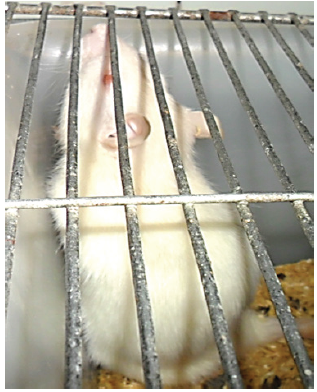
When observing the behavior of experimental animals, it was established that after 60minutes, the rats began to drink water, after 4-5 hours, the entire volume of the proposed drink was drunk-350ml. Control rats, during this time, drank 60ml of water. All the animals of O1 preferred e to water. In the future, they ate food 50% less. The water did not drink. Through 7 days persists preference E, but on 20% increased consumption feed and this raising persisted until the end of experiment. From the first day the behavior of animals changed, increased contact between animals, grooming. So, the first day there was activity and curiosity, after 72 hours the activity decreased, the rats became drowsy and apathetic. Continued to drink E drinks, feed consumption increased by 30%. Communication of rats was limited to communication of individuals within a cage, “grouping” was created, and external stimuli did not distract them from each other. Being in a vertical stand took 20-30% of the time of observation of animals (8 hours), normally 10-15%. An increase in the number of vertical uprights indicates an internal alarm. On day 10 reaction only when adding a new portion of the drink. The absence of E caused concern, the animals were near the drinking trough and waiting for a new portion (Figure 1).

Figure 1:Rats waiting for a new portion.


LA-the effect of these cocktails is similar to the action of energy drinks, but the effect is faster and more pronounced. Through 20-30 minutes they already not departed from drinkers with LA. Dynamics behavior animals: in the first 60-90 minutes arousal, then drowsiness, expressed intoxicating effect, through 5-6 hours increased communication between animals, declined reaction on external stimuli, rats await only drink. Water consumption decreased by 10%, food by 40-50%. Animals are waiting every day they drank 350ml of the drink and demanded more. LA’s absence caused anxiety and aggression. Aggression manifests itself even relative to employees, which daily fed animals, to which animals are accustomed. From the first hours They closed on communication within the “community” of animals, limited to the cell. Being in a vertical rack takes 30-40% of the time, normally 10-15%. This demonstrates the presence of internal anxiety. On day 10, the external reaction only when adding a new portion of the drink. Low feed consumption is maintained. The lack of water is alarming; the animals are next to the drinker and waiting for a new portion. In this group there can be a fight. Rats wait for supplements, which drink, if you add them to the drinker. One rat from 4-’ s unsupportable to drink water and there is fodder, and through 7 days it is died, Figure 3. The attraction to LA and E did not depend on the sex of the experimental animals [3, 4]. The dependence on the age of rats is traced. After autopsy, it was found that young rats have lesions characteristic of old rats- pneumonia, dystrophy and hemorrhages in the myocardium, uneven blood filling of the myocardium uneven blood filling of the myocardium there are areas of weak blood filling alternating with foci of venous-capillary fullness. After that, the behavior of the animals changed while in the cage, a group of animals “closed in their circle”, they almost did not respond to external irritation-the approach of employees to the cage or noise effects: voice, tapping on the cage. Communication between animals was active. They adopted a vertical stance, touching each other with their front paws, which was different from the usual behavior (they sleep during the day). There was an active reaction to the drinking bowl. On the morning on additive a new helpings drinks, in another time on removing this drinker, especially ranging with 3 -’s days use water.

Figure 2:Rats are waiting for a soft drink low alcohol.


Figure 3:White rats, control weight bodies 200 propulsion A. after E mass bodies becomes 350g; after reception LA-120g.


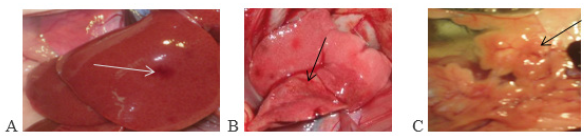
Figure 4:A. Liver closeup, subcapsular hemorrhage, B. Lungs, edema, hemorrhage, C. Pancreatic edema, enhanced vascular pattern. 14 days after using LAD.


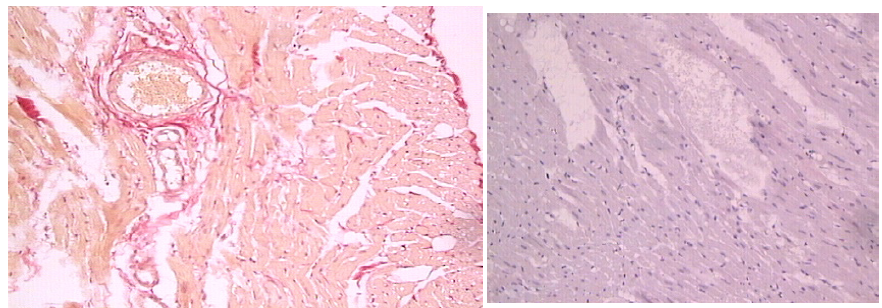
Autopsy on day 14: -in the liver, subcapsular hemorrhage in each animal. Autopsy on day 45: “YOUNG” - starting from day 14, damages in the liver, lungs. pancreatic (Figure 3). Pneumonia in three rats, lungs - abscesses in two rats. Young rats quickly get used to it, increases tolerance to alcoholic beverages. In rats there is a habit and craving for an alcoholic beverage, the intoxicating effect occurs faster than at the beginning of drinking 45% alcohol. There are diseases (pneumonia, myocardial damage) characteristic of older animals. Alcoholic myocardial damage (Figure 4 & 5). All these changes occur faster and more pronounced in those animals that have previously drunk E, it is alarming that by LA and E there is a habit and a need to increase the dose of these drinks. Hierarchy of needs is changing, the instinct of self-preservation is practically no drinking or food craving, especially after LA. The survey of students is anonymous, the data were not disclosed. Students drink these drinks to increase the tone and ability to assimilate new educational material, but teachers note the opposite effect. A small temporary rise in tone (5-6 hours) was replaced by drowsiness and loss of strength. If a student consumed several cans of e, then memorization and assimilation of new skills decreased

Figure 5:Rats. Microphotographs of the myocardium after LA (h&e x160).


Conclusion

Young animals lose sense of self-restraint relative to LA and E. They drink all, that give and require still, in the absence of drinks emerges aggression to other animals and to service personnel. In young animals, the motivation for self-preservation is reduced. In the cell, groups of animals are created, showing interest in each other only within the group. In young animals, damage to the heart, lungs, kidneys, liver was noted, occurring only in old rats. Rejuvenation of chronic diseases. Reception of the studied drinks facilitates the transition to stronger alcoholic beverages (vodka), control animals do not drink vodka of any concentration. Observation of animals allows you to dispense drinks. We know the beginning of the use and could assess the behavior of animals for a long time period. Young people who used e did not have the effect that they expected, but there was an addiction to E. We believe that we can translate the data obtained from animals to humans.

References

  1. Trubitsyna IE, Fedotova TF, Mikhalev IV, Efremov LI, Kleschev VN, et al. (2018) Alcohol-associated internal injuries in rats. Clin Exp Gastroenterol 6(154): 90-93.
  2. Trubitsyna I, Fedotova T, Varvanina G (2019) Metabolic changes in violation in the system of neuro-endocrine regulation after consumption of energy and small-alcoholic beverages. “2nd World Congress on Gastroenterology & Hepatology”, London, UK, p.12.
  3. Acheson A, Mahler SV, Chi H, De Wit H (2006) Differential effects of nicotine on alcohol consumption in men and women. Psychopharmacology (Berl) 186(1): 54-63.
  4. Barrett SP, Tichauer M, Leyton M, Pihl RO (2006) Nicotine increases alcohol self-administration in non-dependent male smokers. Drug Alcohol Depend 81(2): 197-204.


For more articles in Gastroenterology Medicine & Research
Please click on below link: https://crimsonpublishers.com/gmr/

Tuesday, March 30, 2021

Modified Heller´s Esophageal Myotomy Associated with Dor’s Fundoplication A Surgical Alternative for the Treatment of Dolico Megaesophagus_ Crimson Publishers

  Modified Heller´s Esophageal Myotomy Associated with Dor’s Fundoplication A Surgical Alternative for the Treatment of Dolico Megaesophagus by AV Madureira F* in Gastroenterology Medicine & Research_ Gastroenterology Medicine & Research


Abstract

The most performed surgery for the treatment of achalasia is Heller´s esophageal myotomy associated or no with anti-reflux fundoplication. We propose in cases of advanced megaesophagus, specifically in the dolico megaesophagus, a technical variation. The aim of this study was to describe Heller´s myotomy modified by Madureira associated with Dor´s fundoplication as an alternative for the treatment of dolico megaesophagus, assessing its effectiveness at through dysphagia scores and quality of life questionnaires.

Materials and methods: Technical Note describing the surgical procedure and presenting the results of three patients with advanced dolico megaesophagus, operated from 2014 to 2017. The technique proposes the dissection of the esophagus intrathoracic, with circumferential release of it, in the most extensive possible by trans hiatal route. Then the esophagus is retracted and fixed circumferentially in the pillars of the diaphragm with six or seven point. The goal is at least on the third part of the esophagus, to achieve its broad mobilization and rectification of it; then is added a traditional Heller myotomy.

Results: The mean dysphagia score in pre-op was 10points and in the post- op was 1.3 points (maximum of 10 points being observed each between the pre and postoperative 8.67 points, 86.7%) The mean hospitalization time was one day. There was no surgical mortality or conversion to open technique. The mean follow-up time was 30.6 months (24-38 months) (Table 1). Heller’s Cardio myotomy modified by Madureira, associated with Dor’s fundoplication is an option to be investigated for the treatment of the dolico megaesophagus.

Keywords: Megaesophagus; Esophageal myotomy; Heller’s myotomy; Dor’s fundoplication; Dysphagia

Summary
Esophageal achalasia is a rare pathology in the population incidence between 0.03 and 1per 100,000 individuals [1]. It doesn’t have age or gender preference. It’s the most common esophageal motility disorder diagnosed [2]. According to his etiology, it can be classified into idiopathic, chagasic, pseudo achalasia. Trimanoma cruzi infection, in the countries of South America (and Brazil), has a relevant impact and is known that about 5% of patients affected by Chagas disease, they turn on achalasia [3] and that the dilation of the esophagus appears to be greater in the chagasic etiology [4]. The pathophysiology of the disease is seen hypertension in the Lower Esophageal Sphincter (LES) and an inability to drive the esophageal content, for aperistalsis or uncoordinated peristaltic movements. Histologically there is destruction or decrease of the mioenteric plexus cells. The condition usually has insidious onset, and its main symptom is dysphagia. Patients are shown to have poor quality of life, are emaciate and are also limited to their work activities. The most commonly used test for diagnosis is the esophageal manometry that evaluates the motility of the esophagus and lower esophageal sphincter pressure (LESP)

https://crimsonpublishers.com/gmr/fulltext/GMR.000573.php

Crimson Publishers: https://crimsonpublishers.com/

For more articles in Gastroenterology Medicine & Research,
Please click on below link: https://crimsonpublishers.com/gmr/

Friday, January 15, 2021

NSAIDs - Associated Damage to the Stomach Mucosa (Experimental Study)_ Crimson Publishers

 NSAIDs - Associated Damage to the Stomach Mucosa (Experimental Study) by Trubitsyna IE* in Gastroenterology Medicine & Research_ Gastroenterology Open Access Journals


Abstract
NSAIDs remain dangerous drugs due to the damaging effect on the mucous membrane of the stomach, intestines. Experimental studies were conducted to study the damaging effects of nimesulide and lornoxicam. It was found that these drugs damage the mucous membrane of the stomach. a non-selective drug has a slightly greater damaging effect. The damaging effect of these drugs enhances motor impairment, a decrease in pH, and an increase in secretion volume. NSAIDs often lead to the formation of acute ulcers of the gastrointestinal mucosa. The development of NSAID-associated ulcerative lesions is due to an imbalance between the factors of defense and aggression in Summary non-steroidal anti-inflammatory drugs Summary nonsteroidal anti-inflammatory drugs the mucous membrane of the gastrointestinal tract [1,2]. AIM of our research was to establish factors that contribute to the development of NSAID associated ulcerative lesions of the gastric mucosa.

Material and Methods
The experiments were carried out on white Wistar rats of both sexes, weighing 190-210g. Before the operation, food was taken away for 18 hours with free access to water [3]. Under ether anesthesia, a laparotomy was performed and the pylorus was ligated, the drug solution was administered through the probe - experimental groups: Nimesulide - experiment 1 (O1) and Lornoxicam - experiment 2 (O2), pH of the solutions of the injected drugs = 4.0 - 4.5, volume - 1 , 0ml, dose - 15mg/kg, the solution was shaken before administration. Control (С) - ligation of the pylorus and the introduction of 1.0ml of physiological saline. Autopsy after 2 hours, the animals were opened under ether anesthesia, and the abdominal cavity was examined. The pH and volume of the gastric contents were measured. Then using a magnifying glass examined the mucous membrane. Damage Index (ID), the total score of the identified lesions was calculated and divided by the number of animals. Points: edema=1; hyperemia=2; single hemorrhages=3; hemorrhages fused = 4; erosion = 5; ulcer = 6.

https://crimsonpublishers.com/gmr/fulltext/GMR.000572.php

Crimson Publishers: https://crimsonpublishers.com/

For more articles in Gastroenterology Medicine & Research,
Please click on below link: https://crimsonpublishers.com/gmr/

Visual-cognitive Skills and Physical Qualities in Elite Soccer: Practical Considerations for Training and Return-to-Play Protocols: Crimson Publishers

Visual-cognitive Skills and Physical Qualities in Elite Soccer: Practical Considerations for Training and Return-to-Play Protocols by Lukasz...