Motor Control Exercises for Software Employees
for their Non-Specific Neck Pain by Mohammad
sheeba kauser in Developments in Anaesthetics & Pain Management_open access publishers in usa
Abstract
This study is to discover a response to this inquiry by researching the effect of motor control
excercises on vague cervical agony. The investigation incorporates 15 female and 15 male age of 35 to
65 .people were isolated into two randomized groups. The members were rethought on the third and
sixth weeks with VAS and Oswestry . results were taken (p>0.05). There were no factually huge contrasts
in VAS results before the treatment Notwithstanding the relations between the gatherings, the two of
them yielded critical information. As indicated by the VAS score of the benchmark group, the VAS score
somewhere in the range of third and sixth weeks is found to be critical, contrasted with the other
gathering (p=0.007; p<0.01).
Keywords: Neck pain, mc kenzie excercises, Motor control excercises
Introduction
Cervical pain is one of the most well-known behind handicap and headaches . It is a medical
problem that can cause serious clinical, social, wellbeing related and monetary misfortunes.
Medicines incorporate pharmacological treatment, active recuperation modalities,
interventional strategies, and activities. Motor control practices were created in the last part
of the 1980s at San Francisco Spine Institute, USA. These activities depend on the adjustment
of muscles. Involving the nonpartisan zone [1]. The point of motor control practices is to build
the pressure on neck muscles, (levetor scapulae, sternocliedo mastoid, trapezius, erector
spinae, deep cervical flexors, suboccipitalis).Three frameworks must work in coordination to
guarantee dependability. The essential one is the aloof framework; vertebrae, aspect joints,
intervertebral plate and tendons; the auxiliary framework is the dynamic solid framework
and the third is neural control instruments (the quality in tendons, ligaments and muscles,
development receptors and transmitters, vestibular, visual framework, criticism) [2]. Engine
control practices were set up to soothe this irregularity and are normally utilized today [3].
Motor control practices are presently utilized in various areas including clinical recovery,
sports exercises, and wellbeing. This kind of activity creates dynamic equilibrium, static
equilibrium, adaptability and useful characteristics of people [4-6]. These center adjustment
practices cause both a physiological enhancement of the muscles and a variation in the neural
structures [7]. Moreover, center adjustment works out, which are utilized as powerful and
static exercises, improve proprioceptive recognition, just as the body’s equilibrium and
quality by guaranteeing strong enhancement and body control [8,9]. Motor control practices
are the isometric compression , which shows as the neck divider pulls out with the isometric
constriction of sternocliedo mastoid on a segmental level. Biomechanically, co-withdrawal is
appropriate for these muscles. constriction that must be clinically noticed is joined by longus
capitus and longus colli; then again, an ordinary compression is joined by rectus capitus
anterior and rectus capitus lateralis [10,11].
Özcan and Çapan, Casey et al., and Rackwitz didn’t arrive at any
critical resolutions in
their randomized, controlled examination, where they researched the
impact of motor control practices in intense, sub-intense and constant
neck pain. Further
investigations are required on this subject in light of the fact that
the quantity of important examinations is deficient, there are
clashing outcomes from various examinations and no critical end
can yet be drawn. Accordingly, further investigations are required
to improve the existence quality for patients. From this viewpoint,
the proficiency of motor control practices on the Neck torment
should be investigated [3,9,12].
Methodology
Study : Experimental study
Number of subjects : Total 30, group A 15 (control group )
group B 15 ( experimental group )
Duration of study : six weeks
Inclusion criteria
1. Both males and females
2. Age 35-65
3. Neck pain complaining
4. No severe injuries,
5. Any accidental deformities
Exclusion criteria
1. No associated muscular issues
2. Any birth deformities
3. Post trauma
4. Unwilling for the examination
5. Non cooperative
Method
30 subjects were selected based on the inclusion criteria, and
a consent form was given to each for the permission to make a
study and was explained the duration of the treatment. Both males
and females were included and divided into two groups 15 each
group A was given stretches along MC kenzie exercises. Group B
was experimental group and was asked to perform motor control
exercises. The examination was planned utilizing a randomized
controlled model (1:1 randomization draw) bringing about
similar number of volunteers in the benchmark group and study
gatherings. Visual Analog Scale (VAS) and Oswestry NECK Pain
Scale v2.0 were utilized to record people’s agony levels. Following
both groups were allotted, activities which were verbally and
outwardly disclosed. Activities were doled out by considering the
actual fitness of the members. Members were later reexamined
regarding their agony levels on the third and sixth seven day stretch
of the program utilizing the VAS and Oswestry Pain scales. Planned
by Fairbanks and later created by Hudson-Cook, Oswestry Scale is
a proposed scale for the assessment of versatility and day by day
life of people with neck pain because of its quality and repeatability
[13,14,15]. In this examination, Motor control practices were
relegated to the treatment gathering, which were isolated in a
randomized, controlled way. As per the adjustment limits of the
volunteers, they were allotted as to learner, medium or progressed
level. Each level comprised of an aggregate of six developments,
each having two and they were finished three times each week with
ten redundancies of each activity.
Result
Results were drawn using spss software 23.0,
calculated the p value which was >0.05 (Table 1-3).
Table 1:Distributions of descriptive characteristics.
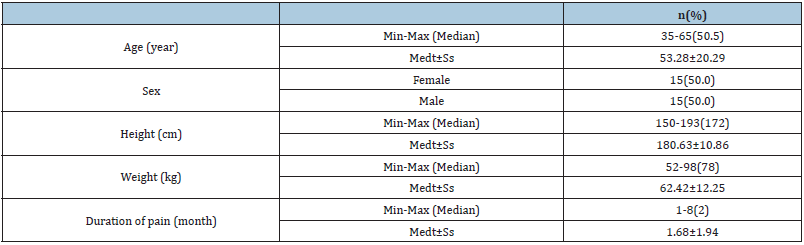
Table 2:
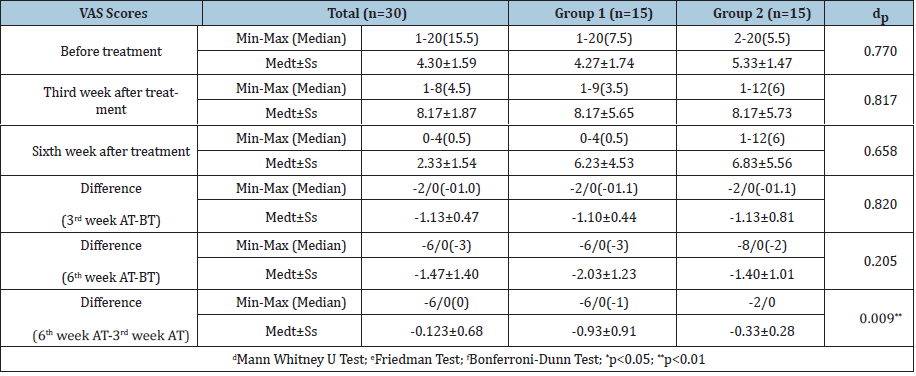
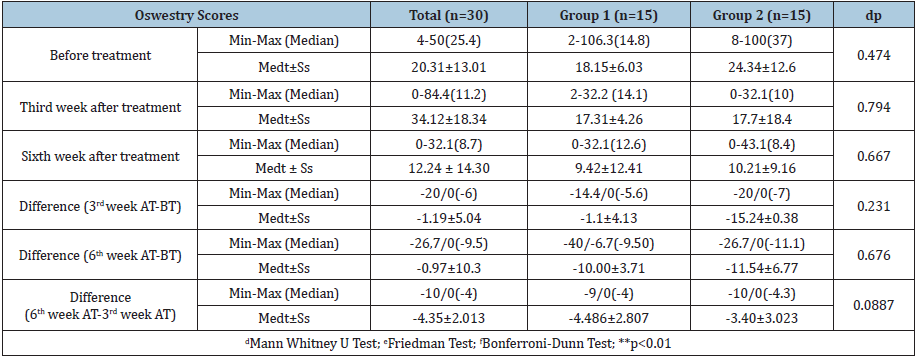
Table 3:Evaluation of Oswestry scores according to groups.
Discussion
The impacts of Motor control practices on vague cervical pain
are researched in this examination. The examination was led more
than two distinctive randomized gatherings with 30 patients and
(1:1) was utilized to help the legitimacy of the investigation and
to accomplish more grounded outcomes. NECK pain is among
the most common musculoskeletal issues in the public arena. Its
conclusion and treatment is a weight on both the individual and the
economy. The reasons for neck pain are 90% mechanical and on the
off chance that it gets ongoing, it might cause practical disabilities
[16]. Inside the extent of our investigation, no measurable
noteworthiness has been found as for the elements old enough and
sexual orientation expanding or diminishing (p>0.05). In different
past investigations concerning , it has been expressed that men are
more inclined to be presented to the neck pain contrasted with
women [17,18]. Based on different investigations in the writing;
Tekgül distinguished that ladies speak to the dominant part,
contrasted with men, with 75% in the main gathering, 73.3% in the
subsequent gathering, 80.6% in the third gathering; while Şahin et
al. discovered 65%; Atar discovered 70% in the first and 80% in the
second gathering [19-21]. In our examination, no huge contrasts
between conjugal status and instructive level were found (p>0.05).
In an investigation, directed by Matsui et al., 170 (27.4%) out of 200
patients with analyzed were hitched, while 30 patients (19.9%)
were either widow/ers or single. No huge connection was found
between conjugal status and (p=0.059, χ2=3.567). The connection
among torment and instructive status, in any case, uncovered that
as the instructive level expanded, torment levels dropped (p=0.001,
χ2=11.879) [22,23]. People with lower instructive levels regularly
work in more ergonomically testing conditions. They are regularly
in word related jobs that include hefty and non-ergonomic actual
exercises. As a psychosocial some portion of the therapy model for
ongoing neck issues practice is a decent choice. In any case, no last
end has been attracted with respect to which exercise programs
are best [24-27]. In our examination, VAS and Oswestry scores
from motor control works out (group 2)and traditional exercise
programs (group a) in patients with neck pain were explored.
A factually huge contrast was found between bunches in this
investigation concerning the third week VAS scores after the
treatment and the sixth week scores (p=0.007; p<0.01); while
the adjustment in Group 2 (drop) is discovered to be higher than
the adjustment in Group 1. No measurably critical distinction has
been seen in the gatherings’ Oswestry information from before the
treatment, on the third week after the treatment (p=0.794) and
the sixth week after the treatment (p=0.667) (p>0.05). In Group
1, a measurably critical change was seen in Oswestry information
(p=0.001; p<0.01). Because of the double correlations, directed
to discover which subsequent meet-ups caused the essentialness;
third week after the treatment (p=0.002) and sixth week (p=0.001),
contrasted with before the treatment, uncovered a huge drop in
Oswestry scores (p<0.01) [28,29]. A measurably critical drop in
the scores of sixth week, contrasted with the third week after the
treatment, was likewise recognized in Oswestry scores (p=0.001;
p<0.01). In Group 2; a factually huge change as per Oswestry
information was found (p=0.001; p<0.01). Because of the double
correlations, directed to discover which subsequent meet-ups
caused the essentialness; third week after the treatment (p=0.001)
and sixth week (p=0,001), contrasted with before the treatment,
uncovered a critical drop in Oswestry scores (p<0.01). Besides, the
drop in the sixth week Oswestry scores, contrasted with the third
week scores, was discovered to be factually huge (p=0.002; p<0.01).
In the examination, huge changes between bunches as far as
Oswestry scores were not found (p>0.05). Nonetheless, when each
gathering was independently assessed, it was seen that the drop
in their scores were huge (p=0.001; p<0.01), (p=0.002; p<0.01).
Tulder et al., who contemplated practice programs, in any case,
didn’t arrive at any resolutions regarding the proficiency of both
exercise models. An examination of both exercise conventions
uncovered differentiating ends. Also, differentiating discoveries
were presented concerning reinforcing and isometric activities,
which were supposed to be more successful than dormant active
recuperation conventions [30].
Conclusion
In our investigation, no demographically huge ends in the
two gatherings, where motor control practices and conventional
activities were doled out against neck pain, were found. Nonetheless,
concerning VAS and Oswestry neck scores, the two gatherings
uncovered critical outcomes. In future study we think can be done
on huge demographical extends and also on larger population.
References
- Fejer R, Kyvik
KO, Hartvigsen J (2006) The prevalence of neck pain in the world
population: A systematic critical review of the literature. Eur Spine J
15(6): 834-848.
- Asplund C, Webb C, Barkdull T (2005) Neck and back pain in Curr Sports Med Rep 4(5): 271-274.
- Korkia PK,
Tunstall Pedoe DS, Maffulli N (1994) An epidemiological investigation of
training and injury patterns in British Br J Sports Med 28(3): 191-196.
- Villavicencio
AT, Hernández TD, Burneikiene S, Thramann J (2007) Neck pain in
multisport athletes. J Neurosurg Spine 7(4): 408-413.
- Weiss BD (1985) Nontraumatic injuries in amateur long-distance bicyclists. Am J Sports Med 13(3): 187-192.
- Wilber CA,
Holland GJ, Madison RE, Loy SF (1995) An epidemiological analysis of
overuse injuries among recreational cyclists. Int J Sports Med 16(3):
201-216.
- Zmurko MG,
Tannoury TY, Tannoury CA, Anderson DG (2003) Cervical sprains, disc
herniations, minor fractures, and other cervical injuries in the
athlete. Clin Sports Med 22(3): 513-521.
- Bertozzi L,
Gardenghi I, Turoni F, Jorge Hugo V, Francesco Capra , et al. (2013)
Effect of therapeutic exercise on pain and disability in the management
of chronic nonspecific neck pain: Systematic review and meta-analysis of
randomized Phys Ther 93(8): 1026-1036.
- Woodhouse A,
Vasseljen O (2008) Altered motor control patterns in whiplash and
chronic neck pain. BMC Musculoskelet Disord 20(9): 90.
- Falla D, Jull G,
Hodges P (2008) Training the cervical muscles with prescribed motor
tasks does not change muscle activation during a functional activity.
Man Ther 13(6): 507-512.
- O Leary S, Jull
G, Kim M, Vicenzino B (2007) Cranio-cervical flexor muscle impairment at
maximal, moderate, and low loads is a feature of neck pain. Man Ther
12(1): 34-39.
- Michaelson P,
Michaelson M, Jaric S, Latash ML, Sjölander P, et al. (2003) Vertical
posture and head stability in patients with chronic neck pain. J Rehabil
Med 35(5): 229-235.
- Falla D, O Leary
S, Fagan A, Jull G (2007) Recruitment of the deep cervical flexor
muscles during a postural- correction exercise performed in sitting. Man
Ther 12(2): 139-143.
- Jull G,
Kristjansson E, Dall Alba P (2004) Impairment in the cervical flexors: A
comparison of whiplash and insidious onset neck pain patients. Man Ther
2004 9(2): 89-94.
- Hanney WJ, Kolber MJ, Cleland J (2010) Motor control exercise for persistent nonspecific neck Phys Ther Rev 15(2): 84-91.
- Jull G, O Leary
SP, Falla DL (2008) Clinical assessment of the deep cervical flexor
muscles: The craniometrical flexion test. J Manipulative Physiol Ther
31(7): 525-533.
- Johnson S, Hall
J, Barnett S, Draper M, Derbyshire G, et al. (2012) Using graded motor
imagery for complex regional pain syndrome in clinical practice: Failure
to improve pain. Eur J Pain 16(4): 550-601.
- Dickstein R, Deutsch JE (2007) Motor imagery in physical therapist practice. Phys Ther 87(7): 942-953.
- Callow N,
Roberts R, Hardy L, Jiang D, Edwards MG (2013) Performance improvements
from imagery: Evidence that internal visual imagery is superior to
external visual imagery for slalom performance. Front Hum Neurosci 7:
697.
- García Carrasco
D, Aboitiz Cantalapiedra J (2013) Effectiveness of motor imagery or
mental practice in functional recovery after stroke: A systematic
Neurologia 31(1): 43-52.
- Lotze M, Halsband U (2006) Motor imagery. J Physiol Paris 99(4-6): 386-395.
- Guillot A,
Moschberger K, Collet C (2013) Coupling movement with imagery as a new
perspective for motor imagery practice. Behav Brain Funct 9: 8.
- Lorey
B, Pilgramm S, Bischoff M, Rudolf Stark, Dieter Vaitl, et (2011)
Activation of the parieto-premotor network is associated with vivid
motor imagery-a parametric FMRI study. PLoS One 6(5): e20368.
- Anwar MN, Tomi N, Ito K (2011) Motor imagery facilitates force field learning. Brain Res 1395: 21-29.
- Gentili R,
Papaxanthis C, Pozzo T (2006) Improvement and generalization of arm
motor performance through motor imagery practice. Neuroscience 137(3):
761-772.
- Schulz KF,
Altman DG, Moher D (2010) CONSORT 2010 statement: Updated guidelines for
reporting parallel group randomized trials. Ann Intern Med
152(11):726-732.
- García Campayo
J, Rodero B, Alda M, Sobradiel N, Montero J, et al. (2008) Validation of
the Spanish version of the Pain Catastrophizing Scale in fibromyalgia.
Med Clin (Barc) 131(13): 487-492.
- Gómez Pérez L,
López Martínez AE, Ruiz Párraga GT (2011) Psychometric Properties of the
Spanish Version of the Tampa Scale for Kinesiophobia (TSK). J Pain
12(4): 425-435.
- Quintana JM,
Padierna A, Esteban C, Arostegui I, Bilbao A, et al. (2003) Evaluation
of the psychometric characteristics of the Spanish version of the
hospital anxiety and depression Acta Psychiatr Scand 107(3): 216-221.
- Herrero MJ,
Blanch J, Peri JM, De Pablo J, Pintor L, et al. (2003) A validation
study of the hospital anxiety and depression scale (HADS) in a Spanish
population. Gen Hosp Psychiatry 25(4): 277-283.
For more articles in open access publishers in usa