Ecotoxicological Impacts of Micro and
Nanoplastics on Marine Fauna by Kuok Ho Daniel
Tang in Examines in Marine Biology & Oceanography_Journal of Oceanography and Marine science
Abstract
Mismanagement of plastics has resulted in increasing plastic wastes in the environment, particularly
the marine environment acting as the ultimate sink of plastics disposed into waters and even onto land.
Micro- and nanoplastics in the marine environment undergo aggregation, sedimentation, deposition and
enter the food chains as they are ingested by marine fauna. The uptake of micro- and nanoplastics by
marine fauna poses multiple ecotoxicological effects comprising the blockage of alimentary canal and
gills, behavioral change, physiological interference especially of the endocrine, antioxidative, immunity
and hepatic systems, as well as adverse effects on reproduction and development of marine fauna. The
ecotoxicological effects are often complicated by the ability of the micro- and nanoplastics to adsorb a
wide range of chemicals. Nanoplastics have been found to affect cellular functions and membrane integrity
and are able to cross the blood-brain barrier of certain aquatic species. The effects vary with the types of
plastics, species of marine fauna, the dose as well as the sizes of plastics. This review systematically and
concisely presents the toxicological effects of micro- and nanoplastics on marine fauna and highlights the
need to understand the effects of these plastics at environmental concentrations instead of experimental
concentrations. It also calls for the study of ecotoxicological effects of micro- and nanoplastics to be
extended to more plastics types and sizes as well as more marine species.
Keywords: Microplastics; Nanoplastics; Marine; Ecotoxicology; Bioaccumulation; Adsorption
Introduction
The presence of micro- and nanoplastics in the environment has become
a hot topic of discussions and scholarly publications due to the
impacts they pose on the ecosystems and the health of both producers and
consumers along the food chains. There is currently a lack of consensus
on the definitions for microplastics and nanoplastics. Desforges et al.
[1] classified plastics of 1μm to 5mm as microplastics 1 while
Rocha-Santos and Duarte called those less than 5mm microplastics [2].
Similarly, the definitions for nanoplastics vary with EU Commission
considering nanoplastics as plastic fragments in the range of 1 to
100nm, [3] and Hartmann et al. [4] defining them as those with sizes
ranging from 1nm to 1μm [4]. Dimensions of the sizes of micro- and
nanoplastics were often not specified, leading to ambiguity in
determining whether the sizes actually referred to the diameters or the
lengths.
Considering the inconsistency in size definitions, in this paper,
microplastics refer to plastic fragments between 100nm and 5mm in any
one of their dimensions while nanoplastics are plastic fragments less
than 100nm in any dimensions [5]. Micro- and nanoplastics enter the
environment through multiple pathways, one of which is through the use
of cosmetic and cleaning products containing micro- or nanobeads [6].
Feedstock for plastics manufacturing and accidental release of plastic
resin pellets or powder from air blasting also constitute direct entries
of micro- and nanoplastics into the environment [7]. Indirectly, micro-
and nanoplastics are formed from the degradation of large plastics
discarded into the environmental via physical, chemical and biological
means, as well as tearing of synthetic lint from cloth washing and
wearing of plastic materials over time [8]. These plastic fragments can
be carried by wind into the atmosphere and eventually settle onto ground
or are washed down by rain. Rainwater runoffs often transport these
fragments from the air or the ground into waterways resulting ultimately
in the entry of micro- and nanoplastics into the marine environment
[9]. The withdrawal of water contaminated with micro- and nanoplastics
to water treatment plants causes entrapment of these plastics in the
sludge produced during water treatment which are later returned to the
environment via application of the sludge as fertilizer [6]. Similarly,
channeling industrial wastewater and blackwater laden with micro- and
nanoplastics to wastewater and sewage treatment plants also results in
their accumulation and escape from these plants. Stephen et al. [10]
found that even 3D printing emitted ultrafine synthetic particles and
this aggravates concerns for the widespread presence of micro- and
nanoplastics in the environment [10].
To date, micro- and nanoplastics have been detected in almost all
ecosystems, particularly the marine and freshwater ecosystems.
Microplastics were found in the water and sediment of inland seas 11 and
ice cores of the Arctic where as much as 38 to 235 particles/m3
of microplastics were reported [11,12]. Desforges et al. [1] reported
9,180 microplastic particles in each cubic meter of seawater of the
Northeast Pacific Ocean, while Norén and Naustvoll revealed a maximum of
102,000 particles in each cubic meter of the Sweden coastal waters
[13]. The prevalence of micro- and nanoplastics was also reported to
have increased twofold in the North Pacific subtropical gyre over the
last forty years, indicating that there is a trend of micro- and
nanoplastics accumulation in the environment over time [12].
As micro- and nanoplastics enter the marine ecosystems, they are
partly removed via abiotic and biotic interactions leading to their
aggregation, sedimentation, deposition and eventual entry into the food
chains [2]. Unlike large plastic litters whose effects on marine
organisms are observable through entanglement, smothering as well as
blockage of the alimentary canal and toxic effects after ingestion, the
environmental and ecotoxicological impacts of micro- and nanoplastics
are not well characterized [14]. This is partly attributed to the
diverse constituents and sizes of micro- and nanoplastics which give
rise to complex biochemical interactions with marine organisms. While
microplastics release chemicals as they are bioaccumulated and
biomagnified up the trophic levels, nanoplastics could interact at
cellular level and may disrupt physiological processes. This mini review
examines the ecotoxicological effects of micro- and nanoplastics
separately to provide better understanding of how these plastics affect
the marine fauna, hence the health of consumers along the marine food
chains.
Ecotoxicological Impacts of Microplastics on
Marine Fauna
Generally, plastics contain additives which can be leached into the
environment and cause various levels of toxicity. Studies showed
correlation between the concentrations of plastic additives in the body
of marine fauna and the amount of plastics they ingested or present in
the environment they inhabited [15]. For instance, the Polybrominated
Diphenyl Ethers (PBDEs) in tissues of mycophid fish sampled from the South Atlantic correlated with the additives of plastics found in the area [16]. Lugworms (Arenicola marina)
sampled from sediments contaminated with polystyrene were also found to
have higher levels of Polychlorinated Biphenyls (PCBs) compared to
those from sediments without polystyrene contamination [17].
Microplastics can adsorb different chemicals in their surroundings such
as phenanthrene, triclosan and nonylphenol and these adsorbed chemicals
can be released together with plastic additives upon ingestion as
already exhibited in the tissues of affected lugworms [18]. Chrysene,
PCB 28 and derivatives of PBDEs were detected in fish which ingested
polyethylene pellets [19].
Other common additives of plastics comprise phthalates, bisphenol A,
acetaldehyde, formaldehyde polyfluoronated compounds and lead heat
stabilizers, each of which exhibits different toxicity to the marine
fauna [20]. Pthalates could interfere with endocrine system in fish via
interacting with hormone receptors [21]. Nonylphenol also exhibited
similar effect [22]. In fact, chemicals leached from microplastics,
particularly Polyethylene Terephthalate (PET) had been found to
demonstrate estrogenic activity [23]. The complex chemicals from
plastics and adsorbed onto microplastics could be disruptive to
ecological structure and functions as well as physiological processes
such as immunity and endocrine system, and animals’ ability to elude
predators. Browne et al. [18] revealed alteration of feeding behavior
and mortality in lugworms which ingested triclosan-sorbed Polyvinyl
Chloride (PVC) [18]. Experimental study on fish fed with microplastics
sorbed with persistent organic pollutants and heavy metals revealed
higher hepatoxicity characterized by glycogen depletion, tumor formation
and lipidosis, as well as endocrine disruption, than microplastics
alone [18,19].
Microplastics have also been reported to disrupt antioxidative system
which plays crucial role in detoxification in living organisms.
Examples of enzymes involved in antioxidative system are catalase,
superoxide dismutase and glutathione peroxidase [24]. Jeong et al. [25]
demonstrated that microplastics increased production of reactive oxygen
species in rotifers and marine copepod, leading to intensified
activities of superoxide dismutase, glutathione peroxidase, glutathione
reductase and glutathione s-transferase [25]. The extent of such
disruption is often size-dependent and contrary to the rationale that
smaller microplastics have longer retention time and higher
bioavailability, hence greater toxicological effects, various studies
found microplastics to exhibit greatest effects at different sizes [24].
Exposing peppery furrow shell (Scrobicularia plana) to
polystyrene at 1mg/L for 14 days in the laboratory resulted in enhanced
activity of superoxide dismutase particularly in the gill and digestive
glands [26]. The study points to tissue-specific responses to
microplastics among marine fauna and the responses are often
species-specific where red mullet (Mullus surmuletus)
demonstrated only a slight increase in the activity of gluthathione with
negligible change in the activities of superoxide dismutase and
catalase in microplastics-enriched environment [27].
Ecotoxicological effects of chemicals-adsorbing ability of microplastics have been demonstrated via enhanced
fluoranthene toxicity of polystyrene contaminated with fluoranthene in
marine mussels which set off oxidative system at cellular level and
interfered with fluoranthene detoxification more intensely than
polystyrene alone [28]. Microplastics are also known to bind antibiotics
and antimicrobials, thus facilitating their transfer to organisms [24].
Ecotoxicological Impacts of Nanoplastics on Marine
Fauna
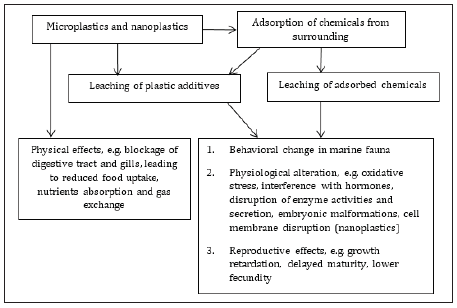
Similar to microplastics, nanoplastics contain chemical additives and
provide the surfaces for adsorption of chemicals which upon release
into the environment or after ingestion, can interfere with
physiological functions and exhibit toxicity on marine fauna (Figure 1).
However, due to their smaller sizes, nanoplastics have larger surface
areas for chemical leaching and adsorption, making them potentially
harder to detect and their effects more complex to characterize than
microplastics. Their small sizes also permit them to interact at
cellular level resulting in another dimension of toxicological concern.
Nanoplastics of polystyrene have been demonstrated to permeate the
membrane bilayers and induce alteration of membrane structure due to
their solubility in the membrane (Figure 1). This hampers diffusion
across membrane and disrupts cell functions [29]. Chemicals adsorbed
onto nanoplastics can enter tissues, causing long-term toxicity [14].
Figure 1: Ecotoxicological effects of micro- and nanoplastics.
Latex nanoparticles were already detected in the gills and intestines of the Japanese rice fish (Oryzias latipes),
and to lesser extent in their liver, blood and brain, thus indicating
the ability of nanoplastics to cross the blood-brain barrier [30].
Exposure to 500nm polystyrene at concentrations of 1.25 and 2.5mg/L was
found to lower fecundity of a marine copepod (Tigriopus japonicus) [5]. Blue mussel (Mytilus edulis)
produced pseudofeces and experienced reduced filtering activity when
exposed to 30nm polystyrene particles at concentrations between 0.1 and
0.3g/L [31]. 50mg/L of 200nm polystyrene stimulated pre-apoptosis among
the Mediterranean mussels (Mytilus galloprovincialis) while 90nm polystyrene at less than 3.85mg/L resulted in deformation in the embryos of sea urchin (Paracentrotus lividus) [32,33].
Nonetheless, Booth et al. [34] revealed negligible toxicity of 2
poly(methylmethacrylate)-based Plastic Nanoparticles (PNPs) and
fluorescent PNPs at concentrations ranging from 500mg/L to 1000mg/L on Corophium volutator [34]. Baudrimont et al. [35] examined the toxic effect of polyethylene nanoplastics on marine diatoms (Thalassiosira weissiflogii)
and found no deleterious effect on their cell growth at concentrations
up to 10,000μg/L [35]. Contrarily, polymethylmethacrylate nanoplastics
at concentrations exceeding 4.69mg/L caused death of rotifers and the
48h median lethal concentration was estimated at 13.27mg/L [36]. Brine
shrimps (Artemia franciscana) exposed to cationic
amino-modified polystyrene nanoplastics showed mortality after 14 days
and 1μg/L of the nanoplastics increased molting in the shrimp larvae
[37]. Similar to microplastics, the toxicity of nanoplastics is
type-specific, species-specific and dose dependent.
Conclusion
With increasing use of plastics and entry of plastics into the
environment, the presence of micro- and nanoplastics in the marine
ecosystems is a persistent problem. In comparison to large plastics,
micro- and nanoplastics are harder to detect and it is significantly
more complicated to characterize their ecotoxicological effects which
are often species-specific, type-specific, size-dependent and
dose-dependent. Micro- and nanoplastics can also adsorb chemicals and
metals from their surrounding which renders understanding of their
ecotoxicological effects even more complex. Current studies focus mainly
on exposing various marine fauna to different types of micro- and
nanoplastics in laboratory and polystyrene micro- and nanoparticles seem
to receive more attention in such studies than other micro- and
nanoplastics. These studies revealed the potential of these plastic
fragments to cause behavioral change and interfere with physiological
processes especially the endocrine and antioxidative systems in marine
fauna. They also affect the growth and reproduction of the marine fauna.
Furthermore, nanoplastics pose the danger of cellular interactions and
membrane disruption. There is a need to also examine the
ecotoxicological effects of these plastics at environmental
concentrations and their interactions with other environmental
contaminants to provide a more realistic picture of how these plastics
affect the marine fauna. Research in this area should be expanded to
different types of micro and nanoplastics commonly present in the marine
environment. With climate change altering the physico-chemical
properties of marine environment, it may also be crucial to examine how
the ecotoxicological effects of micro- and nanoplastics are influenced
[38,39].
References
- Desforges
JPW, Galbraith M, Dangerfield N, Ross PS (2014) Widespread distribution
of microplastics in subsurface seawater in the NE Pacific ocean. Mar
Pollut Bull 79(1-2): 94-99.
- Rocha
ST, Duarte AC (2015) A critical overview of the analytical approaches
to the occurrence, the fate and the behavior of microplastics in the
environment. TrAC Trends Anal Chem 65: 47-53.
- (2011) EU Commission. Plastic Waste: Ecological and Human Health Impact. Europe.
- Hartmann NIB, Nolte T, Sørensen MA, Jensen PR, Baun A (2015) Aquatic
ecotoxicity testing of nanoplastics: Lessons learned from
nanoecotoxicology. Aquatic Sciences Meeting, Denmark.
- Costa JP,
Santos PSM, Duarte AC, Rocha ST (2016 ) (Nano)plastics in the
environment-Sources, fates and effects. Sci Total Environ 566-567:
15-26.
- Carr
SA, Liu J, Tesoro AG (2016) Transport and fate of microplastic
particles in wastewater treatment plants. Water Res 91: 174-182.
- Zbyszewski
M, Corcoran PL, Hockin A (2014) Comparison of the distribution and
degradation of plastic debris along shorelines of the great lakes, North
America. J Great Lakes Res 40(2): 288-299.
- Shim W, Song YK, Hong SH, Jang M, Han GM, et al. (2014) Producing
fragmented micro-and nano-sized expanded polystyrene particles with an
accelerated mechanical abrasion experiment. Switzerland, pp. 11-15.
- Jiang JQ (2018) Occurrence of microplastics and its pollution in the environment: A review. Sustain Prod Consum 13: 16-23.
- Stephens B, Azimi P, Orch Z, Ramos T (2013) Ultrafine particle emissions from desktop 3D printers. Atmos Environ 79: 334-339.
- Dai
Z, Zhang H, Zhou Q, Yuan T, Tao C, et al. (2018) Occurrence of
microplastics in the water column and sediment in an inland sea affected
by intensive anthropogenic activities. Environ Pollut 242: 1557-1565.
- Obbard
RW, Sadri S, Wong YQ, Khitun AA, Baker I, et al. (2014) Global warming
releases microplastic legacy frozen in Arctic Sea ice. Earths Futur
2(6): 315-320.
- Norén F, Naustvoll LJ (2010) Survey of microscopic anthropogenic
particles in Skagerrak. Rep Comm by Climate and Pollution Directorate.
Sweden.
- Lambert S,
Sinclair C, Boxall A (2014) Occurrence, degradation, and effect of
polymer-based materials in the environment BT. Reviews of Environmental
Contamination and Toxicology 227: 1-53.
- Lavers JL, Hodgson JC, Clarke RH (2013) Prevalence and composition of marine debris in Brown Booby (Sula leucogaster) nests at Ashmore Reef. Mar Pollut Bull 77(1-2): 320-324.
- Rochman CM,
Kurobe T, Flores I, Teh SJ (2014) Early warning signs of endocrine
disruption in adult fish from the ingestion of polyethylene with and
without sorbed chemical pollutants from the marine environment. Sci
Total Environ 493: 656-661.
- Besseling E,
Wegner A, Foekema EM, Heuvel GMJ, Koelmans AA (2013) Effects of
microplastic on fitness and PCB bioaccumulation by the lugworm Arenicola marina (L.). Environ Sci Technol 47(1): 593-600.
- Browne MA,
Niven SJ, Galloway TS, Rowland SJ, Thompson RC (2013) Microplastic moves
pollutants and additives to worms, reducing functions linked to health
and biodiversity. Curr Biol 23(23): 2388-2392.
- Rochman CM, Hoh
E, Kurobe T, Teh SJ (2013) Ingested plastic transfers hazardous
chemicals to fish and induces hepatic stress. Sci Rep 3(1): 3263.
- Lithner D,
Larsson Å, Dave G (2011) Environmental and health hazard ranking and
assessment of plastic polymers based on chemical composition. Sci Total
Environ 409(18): 3309-3324.
- Grün F,
Blumberg B (2007) Perturbed nuclear receptor signaling by environmental
obesogens as emerging factors in the obesity crisis. Rev Endocr Metab
Disord 8(2): 161-171.
- Kawahata H,
Ohta H, Inoue M, Suzuki A (2004) Endocrine disrupter nonylphenol and
bisphenol a contamination in okinawa and Ishigaki Islands, Japan-within
coral reefs and adjacent river mouths. Chemosphere 55(11): 1519-1527.
- Z YC, YS I,
Craig JV, KD J, BG D (2011) Most plastic products release estrogenic
chemicals: A potential health problem that can be solved. Environ Health
Perspect 119(7): 989-996.
- Prokić
MD, Radovanović TB, Gavrić JP, Faggio C (2019) Ecotoxicological effects
of microplastics: Examination of biomarkers, current state and future
perspectives. TrAC Trends Anal Chem 111: 37-46.
- Jeong CB,
Kang HM, Lee MC, Kim DH, Han J, et al. (2017) Adverse effects of
microplastics and oxidative stress-induced MAPK/Nrf2 pathway-mediated
defense mechanisms in the marine copepod Paracyclopina nana. Sci Rep 7(1): 41323.
- Ribeiro F, Garcia AR, Pereira BP, Fonseca M, Mestre NC, et al. (2017) Microplastics effects in Scrobicularia plana. Mar Pollut Bull 122(1-2): 379-391.
- Alomar C, Sureda A, Capó X, Guijarro B, Tejada S, et al. (2017) Microplastic ingestion by Mullus surmuletus Linnaeus, 1758 fish and its potential for causing oxidative stress. Environ Res 159: 135-142.
- Paul PI, Lacroix C, González FC, Hégaret H, Lambert C, et al. (2016) Exposure of marine mussels Mytilus spp. to polystyrene microplastics: Toxicity and influence on fluoranthene bioaccumulation. Environ Pollut 216: 724-737.
- Rossi G, Barnoud J, Monticelli L (2014) Polystyrene nanoparticles perturb lipid membranes. J Phys Chem Lett 5(1): 241-246.
- Almutairi
MMA, Gong C, Xu YG, Chang Y, Shi H (2016) Factors controlling
permeability of the blood-brain barrier. Cell Mol Life Sci 73(1): 57-77.
- Wegner A,
Besseling E, Foekema EM, Kamermans P, Koelmans AA (2012) Effects of nano
polystyrene on the feeding behavior of the blue mussel (Mytilus edulis L.). Environ Toxicol Chem 31(11): 2490-2497.
- Canesi L,
Ciacci C, Bergami E, Monopoli MP, Dawson KA, et al. (2015) Evidence for
immunomodulation and apoptotic processes induced by cationic polystyrene
nanoparticles in the hemocytes of the marine bivalve Mytilus. Mar Environ Res 111: 34-40.
- Della TC,
Bergami E, Salvati A, Faleri C, Cirino P, et al. (2014) Accumulation and
embryotoxicity of polystyrene nanoparticles at early stage of
development of sea urchin embryos Paracentrotus lividus. Environ Sci Technol 48(20): 12302-12311.
- Booth AM,
Hansen BH, Frenzel M, Johnsen H, Altin D (2016) Uptake and toxicity of
methyl methacrylate-based nano plastic particles in aquatic organisms.
Environ Toxicol Chem 35(7): 1641-1649.
- Baudrimont
M, Arini A, Guégan C (2019) Ecotoxicity of polyethylene nanoplastics
from the North Atlantic oceanic gyre on freshwater and marine organisms
(microalgae and filter-feeding bivalves). Environ Sci Pollut Res, pp.
1-10.
- Venâncio C,
Ferreira I, Martins MA, Soares AMVM, Lopes I, et al. (2019) The effects
of nanoplastics on marine plankton: A case study with
polymethylmethacrylate. Ecotoxicol Environ Saf 184: 109632.
- Bergami E,
Pugnalini S, Vannuccini ML, Manfra L, Faleri C, et al. (2017) Long-term
toxicity of surface-charged polystyrene nanoplastics to marine
planktonic species Dunaliella tertiolecta and Artemia franciscana. Aquat Toxicol 189: 159-169.
- Tang KHD
(2019) Climate change in Malaysia: Trends, contributors, impacts,
mitigation and adaptations. Sci Total Environ 650(pt 2): 1858-1871.
- Tang KHD (2019) Are we already in a climate crisis? Glob J Civil Environ Eng 1: 25-32.


