Crimson Publishers High Impact Journals

Showing posts with label physical rehabilitation medicine journal. Show all posts

Friday, August 26, 2022

Providing Fair Payment for Prescription Medications in the United States_Crimson Publishers

Providing Fair Payment for Prescription Medications in the United States by Michael M Costello in Examines in Physical Medicine and Rehabilitation: Open Access_physical rehabilitation medicine journal


Opinion

With US health care costs now approaching $3 trillion per year, strenuous efforts to restrain cost growth continue to focus the efforts of policymakers at the federal and state levels. With pharmaceuticals contributing about 20% of total domestic health expenditures, pharmaceuticals are a natural target of cost control efforts. A primary means of attempting to control pharmaceutical costs in the use of Pharmacy Benefit Managers (PBMs), intermediary firms which function as go-betweens in the payer-provider relationship. Medicare, most state Medicaid programs, and many private managed care organizations use PBMs to manage pharmaceutical use for their beneficiaries.

However, a recent review of regulatory efforts combined with the complaints of many retail community pharmacies raises questions as to whether PBMs always act in the best interest of patients, and whether their benefit management practices are harming independent community retail pharmacies. Arnold [1] indicates that PBMs generate their revenues from three primary sources: fees generated from the supply chain, rebates provided by manufacturers and “spreads,” the difference between what the insurer pays the PBM and what the PBM pays the pharmacy which dispenses the medication.

A noted lack of transparency in PBM operations arises from two of those revenues streams. Critics have argued that payers are not benefitting fully from the rebates which PBMs receive from pharmaceutical manufacturers. In addition, pharmacies argue that PBMs are not adequately reimbursing them and are retaining an undue share of the revenues derived from the payers. The market dynamic of PBMs is further complicated by the fact that three large PBMs control 76% of the market of PBM services, and each of the three is owned by a major health insurance company which stands to benefit financially from decisions made by its affiliated PBM Morgan [2].

Smaller independent retail pharmacies complain that they do not have the ability to negotiate favorable acquisition costs and that PBMs reimburse them at less than their acquisition costs for certain prescriptions and charge the pharmacies back for certain patient management discrepancies. Such practices put the pharmacies in a tenuous financial position, leading some to believe they may close. Several large regional grocery store chains that maintained pharmacy counters in their stores are closing or selling those services Terlep [3].

These concerns have been brought to the attention of the US Senate Finance Committee which has written to the US Department of Health and Human Services requesting that it reform the Direct and Indirect Remuneration System by which PBMs remit funds to Medicare Morgan [4]. State legislators are expected to address PBM issues, including rebates to state Medicaid programs and private health insurance companies.

Some suggested areas for consideration in reforming PBM practices are:

Require that all pharmaceutical company rebates be paid to the insurance carrier

Medicare currently requires that all manufacturer rebates be paid back to the program in order to help reduce Part D prescription drug benefits. Such a requirement should be put in place for all payers using PBMs.

Devise a standardized administrative fee protocol

Rather than tying administrative fees together with manufacturer rebates as the Medicare DIR mechanism does, separate the two so as to clarify fees from rebates. Fees can then be regulated as a percentage of rebate payments.

Regulate the “spread” between PBM payments to pharmacies for prescriptions and the acquisition costs which the pharmacies incur

Smaller independent retail pharmacies should not be penalized for the acquisition costs they pay. They should be assured of a fair reimbursement tied to their acquisition costs.

Investigate PBM-insurer relationships for anticompetitive practices

Since the three largest PBMs are owned by large national insurance companies, they have the ability to favor their insurance companies to the detriment of the pharmacies with which they deal. Concerns lie not only with reimbursement rates paid to pharmacies but with the control PBMs exert over provider network configuration.

References

  1. Arnold J (2018) Are pharmacy benefit managers the good guys or bad guys of drug pricing.
  2. Morgan BT (2020) What’s the cost. The Scranton Sunday Times. p. A14.
  3. Telep S, Kang J (2020) Groceries exit from pharmacy business. Wall Street Journal. p. B1.
  4. Morgan BT (2020) Independent pharmacies stuck in a difficult spot. The Scranton Sunday Times. p. A13.
For more articles in physical rehabilitation medicine journal
Please click on below link: https://crimsonpublishers.com/epmr/

Friday, June 3, 2022

Muscle Synergy Analysis for Rehabilitation_Crimson Publishers

Muscle Synergy Analysis for Rehabilitation by Yasuharu Koikey in Examines in Physical Medicine and Rehabilitation: Open Access_physical rehabilitation medicine journal


Abstract

As the population ages globally, the number of patients such as strokes is increasing. Motor function often impaired after a stroke, and QOL is significantly damaged. Therefore, rehabilitation is necessary, but there are few effective methods yet. After the damages to the motor cortex by stroke, some motor functions are affected, but the rehabilitation training can induce the reorganization in the adjacent intact cortex and motor functions may be recovered. The musculoskeletal system plays a role in bridging brain activity and motor function. Even though the movement appears to be the same, the muscle activity may have changed. Muscle synergy plays an important role in visualizing muscle activity because it can express activity patterns that depend on tasks more than muscle activity alone.

Keywords: Muscle synergy; Rehabilitation; Stroke

Introduction

As the population ages globally, the number of patients such as strokes is increasing. Motor function often impaired after a stroke, and QOL is significantly damaged. Therefore, rehabilitation is necessary, but there are few effective methods yet. Rehabilitation is a kind of motor learning and support to acquire the new skill for new environments. It is caused by damage to the brain due to a stroke, and loss of brain function. It means that the body remains healthy, but the motor performance was affected. The brain control many muscles for controlling our body and our body has redundant joint system. It means that even though the hand position is fixed, there are many combination of joints angles to realize same hand position. In order to overcome this problem, the brain coordinates degrees of freedom by changing muscle activities [1]. Muscle activities caused by combination of motor units in spinal cord. A module of motor units in the spinal cord generates a specific muscle activation pattern [2]. Primary motor cortex sends the command to the spinal cord to control these module, but it is still unknown about the mechanisms of coordination of these modules. To reveal this mechanisms, muscle activation patterns are measured and muscle synergy concept is used [3,4]. Some researchers have also been conducted on how motor function recovery occurs during rehabilitation after stroke from the viewpoint of muscle synergy [5,6].

Muscle Synergy

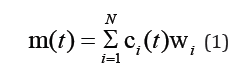
Muscle synergy is coordination of some muscles and a small number of muscle synergies are used to accomplish a task. There are various algorithms can be used to calculate the muscle synergies. A number of different factorization algorithms are assessed to identify muscle synergies [7].

where m(t) is a vector that species the muscle activation at time t, and ci(t) is the time series of muscle synergies. wi is a time invariant vector of muscle synergy. They tested Principal Component Analysis (PCA), Factor Analysis (FA), Independent Component Analysis (ICA) and Non-negative Matrix Factorization (NMF). Each algorithm showed different performance for different noise characteristics, NMF was performed well and robust. Recently NMF is frequently used to acquire the muscle synergies. Equation (2) shows the time varying synergies [8].

They analyzed the muscle patterns of intact and unrestrained frogs dring kiking and showed that combinations of three timevarying muscle synergies required to kick in different directions. Same group tested the time-varying muscle synergies during jumping, swimming and walking using frogs and also showed a small number of synergies were behavior specific [2,9]. These findings indicated that the muscle synergies are related to movement kinematics and dynamics. Cortical damage impairs motor command to the spinal cord and resulting in abnormal movement. Therefore, muscle synergy analysis from stroke patients found the relationship between the muscle activation pattern and the severity of functional impairment [10,11].

Discussion

Where is the source of muscle synergy? This is quite difficult question to answer. Muscle synergy, which is acquired using NMF algorithm, depends on the task. Muscle activation pattern during some task depends on the task. The number of synergy is unknown, so the muscle synergy patterns vary with required accuracy The index, such as Fugal-Meyer assessment score, Brainstorm stage, Functional Independence Measure (FIM), are widely used for indicating the degree of disability These indexes are mainly evaluate the motion or range of motion. Muscle synergies will become useful indexes of both kinematics, dynamics and degree of disability. After the damages to the motor cortex, some motor functions are affected, but the rehabilitation training can induce the reorganization in the adjacent intact cortex and motor functions may be recovered using undamaged motor cortex [12]. The musculoskeletal system plays a role in bridging brain activity and motor function. Brain activities are difficult to measure during the rehabilitation, but EMG can be measured. Even though the movement appears to be the same, the muscle activity may have changed. Muscle synergy plays an important role in visualizing muscle activity because it can express activity patterns that depend on tasks more than muscle activity alone.

Acknowledgement

This work was partially supported by JSPS KAKENHI Grant Number 19H05728, JST-Mirai Program Grant Number JPMJM18C8, Tateishi Science and Technology Foundation Grant Num- ber 2188001, and JST PRESTO Grant Number JPMJPR17JA.

References

  1. N Bernstein (1967) The coordination and regulation of movements, USA.
  2. Bizzi E, Cheung VCK, Avella DA, Saltiel P, Tresch M (2008) Combining modules for movement. Brain Research Reviews 57(1): 125-133.
  3. Matthew CT, Philippe S, Emilio B (1999) The construction of movement by the spinal cord. Nature Neuroscience 2(2): 162-167.
  4. Simon AO, Avella DA, Roh J, Carmena JM, Bizzi E (2015) Representation of muscle synergies in the primate brain. Journal of Neuroscience 35(37): 12615-12624.
  5. Denise JB, Reinhard G, Timothy E, Dinesh KP, Andrea DA (2013) Differences in adaptation rates after virtual surgeries provide direct evidence for modularity. Journal of Neuroscience 33(30): 12384-12394.
  6. Lena HT, Hillel JC, Randy DT, Jessica LA, Lucas JK, et al. (2015) Neuromechanical principles underlying movement modularity and their implications for rehabilitation. Neuron 86(1): 38-54.
  7. Matthew CT, Vincent CKC, Andrea DA (2006) Matrix factorization algorithms for the identification of muscle synergies: Evaluation on simulated and experimental data sets. Journal of Neurophysiology 95(4): 2199-2212.
  8. Andrea DA, Philippe S, Emilio B (2003) Combinations of muscle synergies in the construction of a natural motor behavior. Nature neuroscience 6(3): 300-308.
  9. Andrea DA, Emilio B (2005) Shared and specific muscle synergies in natural motor behaviors. Proceedings of the National Academy of Sciences 102(8): 3076-3081.
  10. Vincent CKC, Lamberto P, Michela A, Stefano S, Andrea T, et al. (2009) Stability of muscle synergies for voluntary actions after cortical stroke in humans. Proceedings of the National Academy of Sciences 106(46): 19563-19568.
  11. Vincent CKC, Turolla A, Agostini M, Silvoni S, Bennis C, et al. (2012) Muscle synergy patterns as physiological markers of motor cortical damage. Proceedings of the National Academy of Sciences 109(36): 14652-14656.
  12. Randolph JN, Birute MW, Frank S, Garrett WM (1996) Neural substrates for the effects of rehabilitative training on motor recovery after ischemic infarct. Science 272(5269): 1791-1794.

Publishers: https://crimsonpublishers.com/

For more articles in physical rehabilitation medicine journal
Please click on below link: https://crimsonpublishers.com/epmr/

Visual-cognitive Skills and Physical Qualities in Elite Soccer: Practical Considerations for Training and Return-to-Play Protocols: Crimson Publishers

Visual-cognitive Skills and Physical Qualities in Elite Soccer: Practical Considerations for Training and Return-to-Play Protocols by Lukasz...