Crimson Publishers High Impact Journals

Showing posts with label Gynecology Open Access Journals. Show all posts

Friday, September 24, 2021

Techniques to Reduce Blood Loss During Open Abdominal Myomectomy: Transverse or Vertical Incision?_ Crimson Publishers

 Techniques to Reduce Blood Loss During Open Abdominal Myomectomy: Transverse or Vertical Incision? by Ozlem Uzunlar* in Investigations in Gynecology Research & Womens Health_ Gynecology Open Access Journals
 

Abstract

Objective: To determine if there is a difference between uterine incision techniques (vertical vs transverse) in terms of clinical results.

Methods: All women with leiomyomas who underwent open abdominal myomectomy (n=61) between March and August 2016 in the Clinic of Gynecology and Obstetrics, Zekai Tahir Burak Women’s Health Care Training and Research Hospital were included and the clinical results were reviewed prospectively.

Result: The estimated blood loss during myomectomy increased in transverse group compared to vertical group (809, 33±483, 34ml vs 405, 32±180, 95ml, p<0.001). The median operative time is 60 minutes and the patients are discharged second day after surgery. No intergroup statistically differences are observed in surgical procedure.

Conclusion: Open abdominal myomectomy causes blood loss however, in transverse incision there is a higher level of estimated blood loss compared to vertical group

https://crimsonpublishers.com/igrwh/fulltext/IGRWH.000563.php

Crimson Publishers: https://crimsonpublishers.com/

For more articles in Gynecology Open Access Journals,
Please click on below link: https://crimsonpublishers.com/igrwh/

Friday, July 9, 2021

Postpartum Ovarian Vein Thrombosis: Clinical Case_ Crimson Publishers

 Postpartum Ovarian Vein Thrombosis: Clinical Case by Ana Ribeiro* in Investigations in Gynecology Research & Womens Health_ Gynecology Open Access Journals


Abstract

Ovarian vein thrombosis (OVT) is a rare but potentially serious postpartum complication, which occurs in 0.05% to 0.18% of pregnancies and is diagnosed on the right side in 80% to 90% of the cases [1,2]. As OVT can mimic acute abdomen it should be considered in the differential diagnosis of postpartum acute abdomen [3]. We present a case of a 29-year-old female who presented a diffuse abdominal pain, fever and vomit on her third postpartum day. Her computed tomography demonstrated left ovarian vein repletion defect compatible with the presence of a thrombus. She was treated with enoxaparin and antibiotics, which lead to a resolution of the thrombus. Our case highlights the importance of prompt diagnosis and treatment of OVT in order to prevent morbidity and mortality

Ovarian vein thrombosis is a rare but potentially serious condition that affects mostly postpartum women, but it may also be associated with a variety of pelvic conditions, such as pelvic inflammatory disease, gynecological surgery, and malignancies [1]. Early recognition and treatment of this condition is needed to avoid the morbidity and the mortality related both to the thrombosis and to any associated infection or sepsis. OVT can occur in 0.02% to 0.18% of pregnancies, 80% to 90% occur in the right side [2]. This is believed to be due, in part, to the dextrorotation of the enlarging uterus that commonly occurs during pregnancy, which compresses the right ovarian vein and right ureter as they cross the pelvic rim [4]. The usual clinical symptoms are pelvic or diffuse abdominal pain, fever and right-sided palpable mass

https://crimsonpublishers.com/igrwh/fulltext/IGRWH.000561.php

Crimson Publishers: https://crimsonpublishers.com/

For more articles in Gynecology Open Access Journals,
Please click on below link: https://crimsonpublishers.com/igrwh/


Thursday, April 15, 2021

Pseudoaneurysm of the Uterine Artery After Abdominal Bilateral Salpingo-Oophorectomy Caused by Tubo-Ovarian Abscess: A Literature Review_ Crimson Publishers

  Pseudoaneurysm of the Uterine Artery After Abdominal Bilateral Salpingo-Oophorectomy Caused by Tubo-Ovarian Abscess: A Literature Review by Hye JD* in Investigations in Gynecology Research & Womens Health_ Gynecology Open Access Journals


Abstract

Uterine artery pseudoaneurysms (UAPs) are rare vascular lesions and may be life threatening if not diagnosed and properly treated. Tubo-ovarian abscess (TOA) represents an end stage process of pelvic inflammatory disease and the definitive therapy is surgery. We describe the case of a woman with a UAP after abdominal bilateral sapling-oophorectomy caused by a TOA. Six days later, she presented with sharp abdominal pain, and a Jackson-Pratt drain was filled with 70cc per hour. Selective uterine artery angiography demonstrated a UAP, and embolization was performed successfully. And we reviewed 10 cases of pseudoaneurysm after a gynecological operation, especially the first symptoms and diagnosis methods. In conclusion, UAP suspicion is required in the event of first symptoms such as vaginal spotting, abdominal discomfort/pain, fever, dizziness, etc. And, if it is suspected even slightly, an imaging works up should be conducted in a timely manner to quickly achieve diagnosis and treatment

https://crimsonpublishers.com/igrwh/fulltext/IGRWH.000560.php

Crimson Publishers: https://crimsonpublishers.com/

For more articles in Journal of Marine Biology,

Please click on below link: https://crimsonpublishers.com/igrwh/

Friday, January 29, 2021

Impact of Cervix Uterine Cancer Screening in the Indian Park of Xingu_ Crimson Publishers

 Impact of Cervix Uterine Cancer Screening in the Indian Park of Xingu by Gois Speck NM* in Investigations in Gynecology Research & Womens Health_ Gynecology Open Access Journals


Abstract

Background: There are few exploratory studies on Human Papillomavirus (HPV) infection and cervical cancer in indigenous populations. Because these women represent a very peculiar population in terms of habits and cultural rituals of its own, HPV infection and its related-oncogenesis potential could not denote the same progression characteristics as compared to the other populations commonly studied. The aim of this study was to evaluate 13 years of cervical cancer screening actions and assistance in the Xingu Indigenous Park, through cytological analysis and DNA-HPV molecular test.

Methods: This is an observational, transversal and retrospective study conducted by data analysis of screening and control actions of uterine cervical HPV-associated lesions in the scope of the Xingu project supported by the Universidad Federal de São Paulo (UNIFESP), Brazil. The population studied consisted of indigenous, sexually active women, aged 11 years or older, belonging to sixteen ethnic groups residing in the middle, lower and east Xingu regions. The women were screening for conventional cervical screening test (Pap test) and HPV tests.

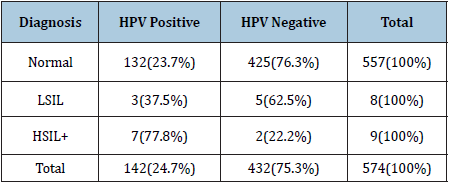
Results: The population coverage for cytological analyses in the entire period averaged 89.4%. Only 3 cases of cervical cancer were documented over the 13 years of follow-up. The HPV positivity rate was 24.5% and latency 22.9%.

Conclusions: It was observed that the high coverage of the population was valuable in maintaining the quality of screening because of the large number of normal Pap tests and rare cases of cancer compared to the national incidence.

https://crimsonpublishers.com/igrwh/fulltext/IGRWH.000559.php

Crimson Publishers: https://crimsonpublishers.com/

For more articles in Gynecology Open Access Journals,
Please click on below link: https://crimsonpublishers.com/igrwh/

Thursday, October 29, 2020

Prevalence of Bacterial Vaginosis in Preterm and Term Labour-An Observational Study _ Crimson Publishers

Prevalence of Bacterial Vaginosis in Preterm and Term Labour-An Observational Study by Kavya K in Gynecology Research & Womens Health_ Gynecology Open Access Journals


Abstract

Objective: To evaluate the association between Recurrent Pregnancy loss and thrombophilia.

Methods: This is a descriptive study, involving retrospective analysis of patients with recurrent pregnancy losses. Patients with recurrent pregnancy loss in whom associated morbidity factors were excluded underwent screening for both acquired and inherited thrombophilia.

Results: A total of 20 patients were screened for acquired and inherited thrombophilia with recurrent pregnancy loss. Thrombophilia was diagnosed in 70% cases. Out of which, Anticardiolipin antibodies was found positive in 57% of patients, Protein C 7% & protein S deficiency was observed in 35 % cases.

Conclusion: Thrombophilias are associated with recurrent Pregnancy loss. Patients in whom other associated morbid factors are excluded, should be offered screening for thrombophilia. Multidisciplinary management involving hematologist is vital for management.

Keywords: Recurrent pregnancy loss; Thrombophilia.

https://crimsonpublishers.com/igrwh/fulltext/IGRWH.000558.php

For more articles in Gynecology Open Access Journals,
Please click on below link: https://crimsonpublishers.com/igrwh/
 

Visual-cognitive Skills and Physical Qualities in Elite Soccer: Practical Considerations for Training and Return-to-Play Protocols: Crimson Publishers

Visual-cognitive Skills and Physical Qualities in Elite Soccer: Practical Considerations for Training and Return-to-Play Protocols by Lukasz...