Crimson Publishers High Impact Journals

Friday, July 16, 2021

Sodium Valproate and Levetiracetam Treatment in Children: Their Effects on Serum Paraoxonase/ Arylesterase Activities_ Crimson Publishers_ Crimson Publishers

Sodium Valproate and Levetiracetam Treatment in Children: Their Effects on Serum Paraoxonase/ Arylesterase Activities by Esra Türe* in Techniques in Neurosurgery & Neurology_ Journal of Neurosurgery


Abstract

Objectives: Investigation of effects of seizures and used antiepileptic drugs on serum Paraoxons 1 (PON1) and aryl esterase (PONAryl) activities in patients diagnosed with epilepsy and simple febrile convulsion was aimed.

Materials and methods: Of the patients who were being followed-up with diagnosis of epilepsy and admitted to emergency department with complaint of seizure; patients using sodium valproate, levetiracetam and diagnosed with simple febrile convulsion were included in the study. In order to measure levels of PON1 and PONAryl, venous blood samples were obtained.

Results: When serum PON1 and PONAryl levels of the groups were compared, PON1 and PONAryl levels were determined to be statistically significantly lower in the epilepsy group using sodium valproate (p=0.001, p=0.001).

Conclusion: Valproate had a potent inhibition effect and levetiracetam had weak inhibition effect on PON1 and PONAryl activities. Results suggest need for close follow-up of these patients with impaired oxidative balance due to increased risk of atherosclerosis.

https://crimsonpublishers.com/tnn/fulltext/TNN.000561.php

Crimson Publishers: https://crimsonpublishers.com/

For more articles in Journal of Neurosurgery,
Please click on below link: https://crimsonpublishers.com/tnn/

Tuesday, July 13, 2021

Hydraulic Fracturing (“Fracking”) and Rebirth of United States Chemical Industry_ Crimson Publishers

 Hydraulic Fracturing (“Fracking”) and Rebirth of United States Chemical Industry by Makarand R Gogate* in Progress in Petrochemical Science_ International Journal of Petrochemical Science


Abstract

The use of hydraulic fracturing the extract oil and gas from the earth, dates back to 1940s, but only in the last decade or so, has the word “Fracking” become a buzzword. Fracking alludes primarily to the shale gas boom in the United States, since about 2008, and also refers to the process - the high pressure injection of water, chemicals, and sand into the shale rock deposits – to release gas and oil trapped within shale rock by fracturing it, to harvest stores of gas and oil, previously unfeasible to access or recover.

As stated above, Fracking became commercial in the United States in 2008, first at the Bakken Shale deposits in North Dakota, and later at Barnett Shale Basin in Texas. The production of domestic natural gas thus saw a high spike in about 2008, and is expected to grow by up to 44% by 2035. For example, the domestic production was at 17Tn cu ft/year in 2008, and now stands at 27Tn cu ft/year (2017), an increase of 59%. As a result, the price of domestic natural gas (Henry Hub Index) was $15.46/MM BTU (2008 basis), and has steadily declined to the current $1.85/MM BTU (2020). The historical trends in the natural gas prices are illustrated in Figure 1; [1]. Not surprisingly, the oil prices, seen historically to trend directly with price of natural gas, have also steadily declined: Oil prices peaked to over $110/bbl (2008) - when the cost of gasoline was over $4/gal -- and have also steadily declined to $30/bbl, as of today. Fracking is a uniquely and hugely successful American story, that, by safely unlocking America’s abundant natural resources, has created millions of jobs, reduced energy prices (oil and natural gas), and also brought cleaner air by significantly reducing greenhouse gas emissions (to lowest levels in 25 years), and transformed the United States back into a global superpower [2]

https://crimsonpublishers.com/pps/fulltext/PPS.000562.php

Crimson Publishers: https://crimsonpublishers.com/

For more articles in International Journal of Petrochemical Science,

Please click on below link: https://crimsonpublishers.com/pps/ 

Monday, July 12, 2021

Symptomatic Nephroptosis (SN) Causes the Loin Pain and Haematuria Syndrome (LPHS)_ Crimson Publishers

 Symptomatic Nephroptosis (SN) Causes the Loin Pain and Haematuria Syndrome (LPHS) by Ahmed N Ghanem* in Surgical Medicine Open Access Journal_ Surgical Medicine Open Access Journal


Abstract

The objective of this letter is to report recent advances on the diagnosis and therapy of the loin pain hematuria syndrome (LPHS). The patho-aetiological link of LPHS with symptomatic nephroptosis (SN) is a novel discovery of the 21st century that was first preliminary reported in 2002 [1]. The link was confirmed in 2016 in an article that précised the exact pathoaetiology of LPHS; ischemic nephritis and sympathetic neuropathy of SN. It also advanced a 100% curative therapy for LPHS namely; the renal sympathetic denervation and nephropexy (RSD&N) surgery [2]. Symptomatic nephroptosis has been known for centuries [3] but was disparaged [4] >70 years ago and omitted from all textbooks. Hence it is a forgotten disease. The loin pain hematuria syndrome was first reported in 1967 [5] and has remained without any effective therapy till now

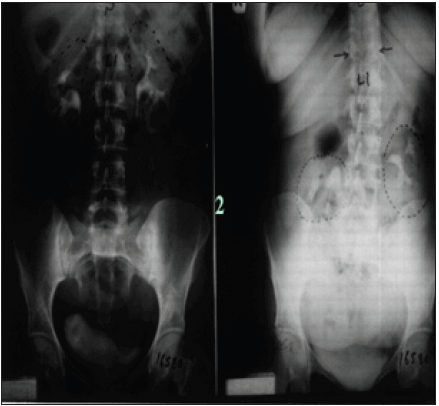
The discovery of SN causing LPHS and the successful curable therapy are based on a prospective cohort 10 years study [1,2] of 190 patients diagnosed with SN among whom 36(18.9%) patients developed LPHS. Two new signs that demonstrate renal pedicle stretch of SN (Figure 1) causes vessel stenosis and ischemic nephritis as evidenced by the new IVU7 sign and tube stretch hypothesis (Figure 2 & 3). These signs demonstrate that stretching of renal artery in pedicle at erect posture causes vessels stenosis, diminished blood flow and induces ischemic nephritis and sympathetic neuropathy. This is illustrated by producing the same effect on stretching a rubber catheter tube causing stenosis (reduced diameter) that diminishes lumen flow. Lumen flow of the blood vessel or catheter is completely obliterated when stretch of more than double the length of vessel or tube is accompanied by rotation twist. Ischemic nephritis affects the renal medulla long before the cortex, particularly eroding the medullary papillae creating fistulae between renal blood vessels and the collecting system explaining the venous shunt causing the hematuria. This is demonstrated only on retrograde pyelography (RGP) (Figure 4 & 5). So, the diagnosis of SN is only possible on intravenous urography (IVU) with erect film (IVU-E) on which the IVU7 sign demonstrates renal drop and pedicle stretch (Figure 1 & 2) and RGP that demonstrates medullary damage (Figure 4 & 5) while all other imaging including CAT and MRI are useless being feasible only on supine posture

https://crimsonpublishers.com/smoaj/fulltext/SMOAJ.000562.php

Crimson Publishers: https://crimsonpublishers.com/

For more articles in Surgical Medicine Open Access Journal,
Please click on below link: https://crimsonpublishers.com/smoaj/


The Efficacy of Sap Obtained from Commiphora gileadensis Against Cadmium-Induced Liver Toxicity in Rats: Crimson Publishers

The Efficacy of Sap Obtained from Commiphora gileadensis Against Cadmium-Induced Liver Toxicity in Rats by Amal S Soliman in Research in Med...