Crimson Publishers High Impact Journals

Tuesday, February 2, 2021

Preparation of Nanostructured Catalysts by Grafting Metal Alkoxides on the Surface of Oxides Supports and their Performances in Some Reactions of Industrial Interest_ Crimson Publishers

Preparation of Nanostructured Catalysts by Grafting Metal Alkoxides on the Surface of Oxides Supports and their Performances in Some Reactions of Industrial Interest by E Santacesaria* in Progress in Petrochemical Science_ International Journal of Petrochemical Science
 

Abstract

Metal alkoxides are nowadays largely employed for preparing ceramic materials, for thin coating films and for supports and catalysts preparation using in the different cases the solgel technique or the chemical vapour deposition [1]. Although very promising, less popular is the employment of metal alkoxides for preparing supports and catalysts by using the grafting technique. This technique can usefully be used for deeply changing the acid-base and/or the redox properties of the surface of an oxide rich of hydroxyls. As the catalytic properties depends almost exclusively on the surface properties of the solid used as catalyst, modifying opportunely the surface by contacting it with reactive substances like the metal alkoxides can give surprising results in terms of activity and selectivity in different reactions. In particular, the properties of the new surfaces obtained by reacting the superficial hydroxyls with a metal alkoxide, after a stabilizing treatment of hydrolysis and calcinations, are quite different from the original surface. A systematic work has been made on the subject by our research group in the past and a review of the most significant obtained results is reported in this paper.

https://crimsonpublishers.com/pps/fulltext/PPS.000560.php

Crimson Publishers: https://crimsonpublishers.com/

For more articles in Progress in Petrochemical Science,
Please click on below link: https://crimsonpublishers.com/pps/

Monday, February 1, 2021

Same Story with Different Endings in HER2- Positive Breast Cancer: Why the Benefit of Pertuzumab is Robust in the Metastatic Scenario and Modest in the Adjuvant Setting_ Crimson Publishers

 Same Story with Different Endings in HER2- Positive Breast Cancer: Why the Benefit of Pertuzumab is Robust in the Metastatic Scenario and Modest in the Adjuvant Setting? by Jayesh Sagar* in Surgical Medicine Open Access Journal_ Journal of Surgical Medicine


Abstract
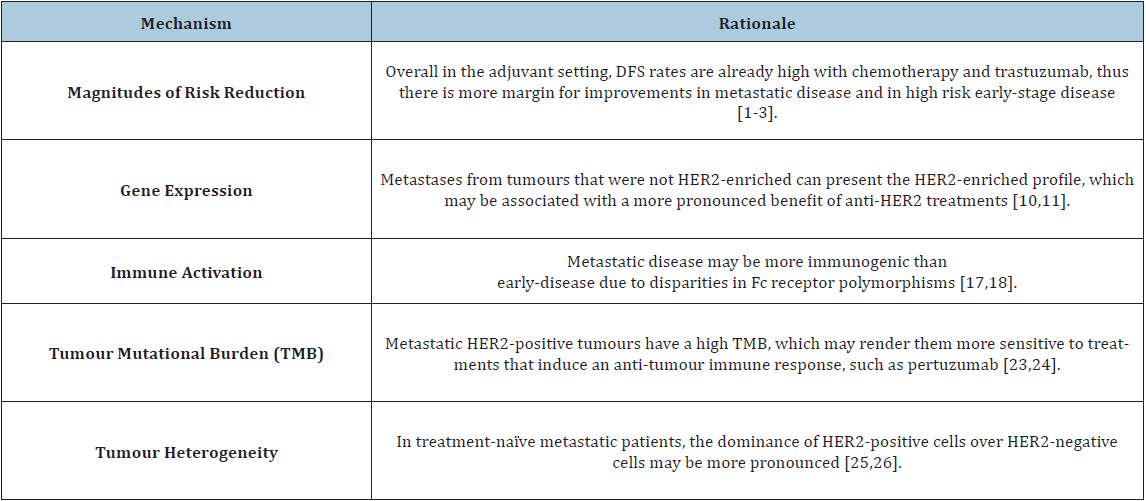
The addition of pertuzumab to chemotherapy and trastuzumab yielded an impressive improvement in the outcomes of metastatic HER2-positive breast cancer patients [1]. Intriguingly, the same magnitude of benefit could not be reproduced with pertuzumab in the adjuvant setting, being the reasons for this discrepancy unknown [2,3]. In this manuscript, we discuss clinical and biological differences between metastatic and early-stage HER2-positive breast cancer, and conclude by proposing potential explanations for the distinct magnitudes of benefit of pertuzumab in different disease settings.

Magnitude of Risk Reduction
When evaluating a new treatment in the context of a clinical trial, events occurring in experimental and control arms are compared [4]. Early-stage HER2-positive breast cancer patients treated with adjuvant chemotherapy and trastuzumab had a 87.8% recurrencefree survival rate at 6 years as per the recently updated results of the APHINITY trial [3]. In the metastatic setting, however, the perspective is different: only 20% of patients receiving chemotherapy and trastuzumab remain alive and progression-free at 3 years [1]. Therefore, events are more frequent in the metastatic setting than in early-disease. In other words, there is more room for improvement in metastatic disease, whereas in the adjuvant setting chemotherapy and trastuzumab already yield high Disease-Free Survival (DFS) rates.

Illustrating this hypothesis, the addition of pertuzumab to trastuzumab and chemotherapy in the metastatic setting yields a 32% relative reduction in the risk of progression, which translates into an 8.2% absolute increase in Progression-Free Survival (PFS) at 3 years, whereas in the adjuvant setting pertuzumab yields a 24% relative reduction in the risk of recurrence at 6 years, translating into a modest 2.8% absolute improvement in invasive DFS (iDFS) [1-3]. When considering only node-positive patients (who present a higher risk of recurrence), the benefit of adjuvant pertuzumab becomes more pronounced (28% relative reduction in recurrence risk yielding a 4.5% absolute 6-year iDFS improvement).

https://crimsonpublishers.com/smoaj/fulltext/SMOAJ.000560.php

Crimson Publishers: https://crimsonpublishers.com/

For more articles in Journal of Surgical Medicine,
Please click on below link: https://crimsonpublishers.com/smoaj/

Visual-cognitive Skills and Physical Qualities in Elite Soccer: Practical Considerations for Training and Return-to-Play Protocols: Crimson Publishers

Visual-cognitive Skills and Physical Qualities in Elite Soccer: Practical Considerations for Training and Return-to-Play Protocols by Lukasz...